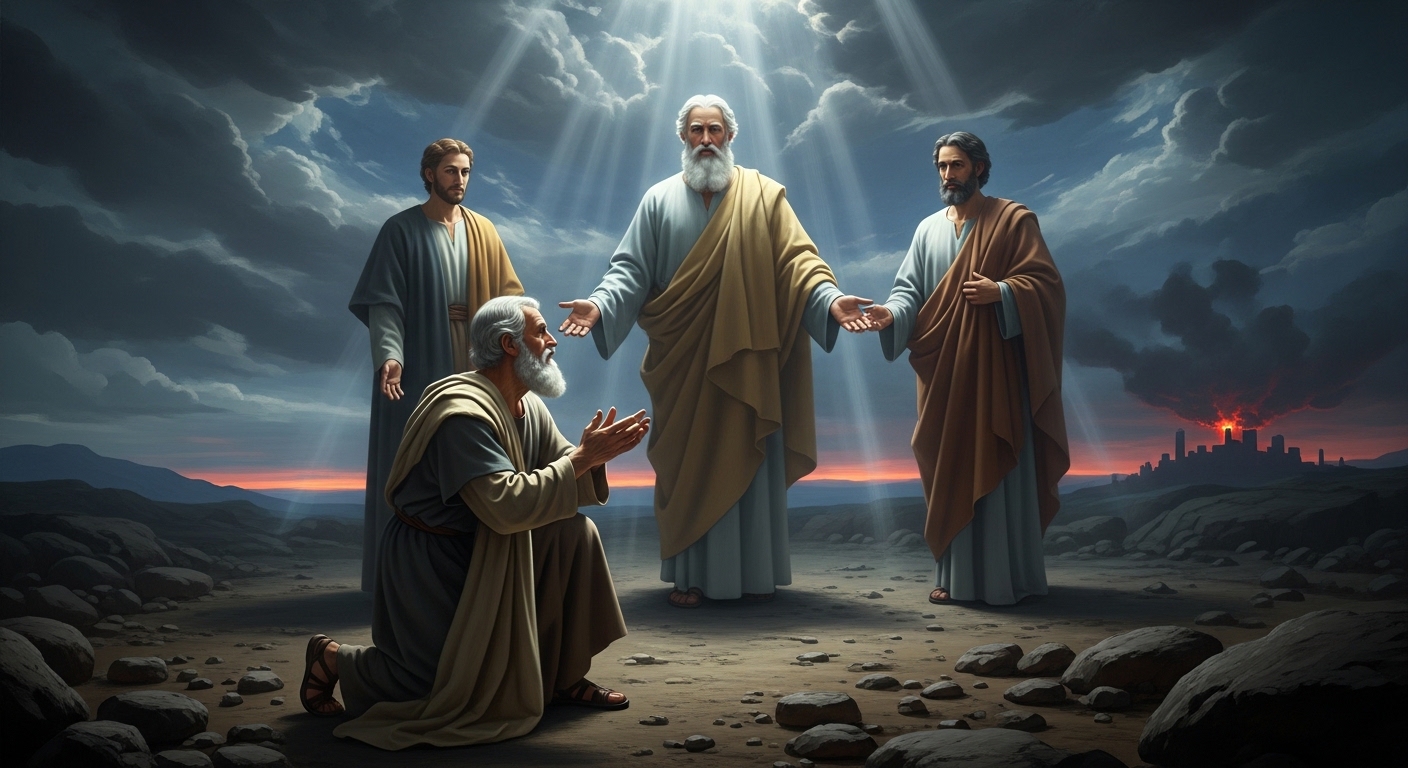
Genesis 18:16-18,23 KJVS
And the men rose up from thence, and looked toward Sodom: and Abraham went with them to bring them on the way. [17] And the LORD said, Shall I hide from Abraham that thing which I do; [18] Seeing that Abraham shall surely become a great and mighty nation, and all the nations of the earth shall be blessed in him? [23] And Abraham drew near, and said, Wilt thou also destroy the righteous with the wicked?
The moment Abraham interceded for Lot is one of the most striking pictures of bold prayer in all of Scripture. It reveals just how unique his relationship with God truly was. Abraham wasn’t approaching a distant ruler—he was speaking to Someone who called him friend.
And because of that friendship, he was allowed to step into a kind of holy negotiation, pleading for the lives of people who weren’t even asking for themselves.
It’s a scene that shows both courage and tenderness. Abraham dares to speak, dares to question, dares to ask again and again—not out of arrogance, but out of love. His boldness flows from relationship, not entitlement. He knows God’s heart well enough to believe that mercy is always worth asking for.
This moment reminds us that true friendship with God gives us the freedom to pray big, honest, compassionate prayers—prayers that stand in the gap for others, just as Abraham did.
The Bold Intercessor
Genesis 18:25 KJVS
That be far from thee to do after this manner, to slay the righteous with the wicked: and that the righteous should be as the wicked, that be far from thee: Shall not the Judge of all the earth do right?
Abraham’s most famous prayer is the one often called his “negotiation” for Sodom—but that word hardly captures the heart behind it. This wasn’t a shrewd bargaining session; it was a man standing barefoot in the dust, carrying the weight of other people’s lives in his chest. He stepped forward—timid, bold, trembling, determined—and spoke to God not as a distant deity but as Someone he had come to trust.
He pleaded for the righteous who might be hidden among the ruins of a broken city. With every question, he was really asking something deeper: Is Your justice big enough to hold mercy? Is Your righteousness wide enough to remember the innocent?
And then came the line that has echoed through centuries, a mixture of courage and reverence: “Shall not the Judge of all the earth do right?” (Genesis 18:25)
It wasn’t defiance. It was faith—faith that God’s character was so good, so steady, so morally beautiful, that Abraham could lean his entire hope on it. In that moment, he became not just a patriarch, but an intercessor: a man who dared to stand in the gap, believing that compassion could still reshape the fate of a city.
1. The Divine Consultation
Genesis 18:17 KJVS
And the LORD said, Shall I hide from Abraham that thing which I do;
The story opens with a striking moment of divine vulnerability. As God prepares to investigate the outcry rising from Sodom, He pauses—not out of hesitation, but out of relationship. He chooses to share His intentions with Abraham, almost as if thinking aloud in the presence of a trusted friend.
There’s a tenderness in the way God frames it. He recognizes Abraham not just as a future patriarch of nations, but as a man who will shape generations in the ways of justice and compassion. Because of that, God refuses to keep him at a distance. Instead, He draws Abraham into the inner circle of His purposes.
It’s as though God is saying, “If Abraham is going to teach his children what righteousness looks like, then let Me model it with him now. Let Me show him how I weigh mercy and judgment. Let Me treat him not as a servant, but as a confidant.”
In this small pause before the storm, we see something profound:
God doesn’t just act—He invites.
He doesn’t just command—He converses.
He doesn’t just judge—He lets Abraham witness the heart behind the judgment.
It’s the beginning of a dialogue that reveals as much about God’s character as it does about Abraham’s. And it sets the stage for one of the most intimate, courageous exchanges between humanity and the divine.
2. The Confrontation
Genesis 18:23,25 KJVS
And Abraham drew near, and said, Wilt thou also destroy the righteous with the wicked? [25] That be far from thee to do after this manner, to slay the righteous with the wicked: and that the righteous should be as the wicked, that be far from thee: Shall not the Judge of all the earth do right?
When the two angels turn and begin their descent toward Sodom, the air shifts. Their footsteps fade into the distance, and suddenly Abraham is alone—standing face‑to‑face with the Lord. It’s a quiet, weighty stillness, the kind that makes a person aware of every beat of their own heart.
Genesis 18:20-22 KJVS
And the LORD said, Because the cry of Sodom and Gomorrah is great, and because their sin is very grievous; [21] I will go down now, and see whether they have done altogether according to the cry of it, which is come unto me; and if not, I will know. [22] And the men turned their faces from thence, and went toward Sodom: but Abraham stood yet before the LORD.
Abraham knows what’s at stake. He knows who lives in that city. Lot isn’t just a relative; he’s family woven into Abraham’s own story—someone he’s rescued before, someone he’s prayed for, someone he still hopes will flourish. And now the city that shelters him is under divine scrutiny.
So Abraham does something incredibly human and incredibly brave: he steps closer.
Not with entitlement. Not with arrogance. But with a trembling kind of courage that comes from knowing God’s character well enough to appeal to it. Abraham approaches the Lord the way a child approaches a parent whose heart he trusts—carefully, but without fear.
It’s as if he’s saying, “I know who You are. I’ve seen Your mercy, Your patience, Your justice. And because I know You, I have to ask…”
This is not a negotiation between equals. It’s a conversation born from relationship. Abraham isn’t trying to change God’s mind; he’s trying to understand God’s heart. And in doing so, he reveals his own—a heart that refuses to stay silent when lives hang in the balance.
In that sacred space between fear and faith, Abraham becomes an intercessor. A bridge. A voice for the vulnerable.
And God listens.
Abraham doesn’t ask God to “be nice”; he asks God to be Just.
3. The Great Negotiation
Genesis 18:24,26,28-32 KJVS
Peradventure there be fifty righteous within the city: wilt thou also destroy and not spare the place for the fifty righteous that are therein? [26] And the LORD said, If I find in Sodom fifty righteous within the city, then I will spare all the place for their sakes. [28] Peradventure there shall lack five of the fifty righteous: wilt thou destroy all the city for lack of five? And he said, If I find there forty and five, I will not destroy it. [29] And he spake unto him yet again, and said, Peradventure there shall be forty found there. And he said, I will not do it for forty’s sake. [30] And he said unto him, Oh let not the Lord be angry, and I will speak: Peradventure there shall thirty be found there. And he said, I will not do it, if I find thirty there. [31] And he said, Behold now, I have taken upon me to speak unto the Lord: Peradventure there shall be twenty found there. And he said, I will not destroy it for twenty’s sake. [32] And he said, Oh let not the Lord be angry, and I will speak yet but this once: Peradventure ten shall be found there. And he said, I will not destroy it for ten’s sake.
Abraham begins what can only be described as a countdown of mercy. It’s not a negotiation in the modern sense; it’s more like a trembling exploration of God’s heart. With each number he speaks—fifty, forty‑five, forty, thirty, twenty—Abraham is feeling out the contours of divine compassion, testing how far grace can stretch before judgment must fall.
There’s a kind of holy audacity in it. Abraham knows he’s dust and ashes, yet he keeps stepping forward, inch by inch, as if he’s walking deeper into the mystery of who God is. Every reduction is a question wrapped in hope: “Is Your mercy big enough for this? What about this? How low can love go?”
And God keeps answering, Yes.
Not impatiently. Not reluctantly. But with a calm, steady willingness that reveals something profound: God is not looking for reasons to destroy—He’s looking for reasons to spare.
Eventually Abraham stops at ten. He doesn’t run out of courage; he runs into a reasonable assumption. Scholars often point out that Abraham likely believed there were at least ten righteous people in Sodom—Lot, his wife, their daughters, and the men pledged to marry them. Ten felt safe. Ten felt possible. Ten felt like enough to tip the scales toward mercy.
But beneath that scholarly logic lies something more human: Abraham is hoping. Hoping that the goodness he longs to see in that city actually exists. Hoping that Lot’s household has grown in righteousness. Hoping that judgment can be held back by even a small cluster of faithful hearts.
In that moment, Abraham isn’t just counting numbers.
He’s counting on God’s character.
He’s counting on mercy being stronger than wrath.
He’s counting on the possibility that even a handful of righteous people can hold back the darkness.
And God lets him ask. God lets him push. God lets him feel the weight and wonder of divine patience.
It’s one of the most intimate portraits of intercession in Scripture—a man daring to believe that God’s compassion might be deeper than anyone imagined.
4. The Outcome: “God Remembered Abraham”
Genesis 19:29 KJ21
And it came to pass, when God destroyed the cities of the plain, that God remembered Abraham, and sent Lot out of the midst of the overthrow when He overthrew the cities in which Lot dwelt.
In the end, Abraham’s hope collapses under the weight of reality. There were not even ten righteous people in Sodom. Whatever goodness Abraham imagined—whatever small cluster of faithful hearts he prayed might hold back judgment—simply wasn’t there. The city had hollowed itself out from the inside, and when the moment came, it could no longer stand.
The destruction is described in sharp outline: “brimstone and fire from the Lord out of heaven.” It’s the kind of language that feels heavy even centuries later, a reminder that choices shape destinies, and that entire communities can drift so far from justice that they unravel.
And yet—even in the middle of this devastation—there’s a quiet thread of grace.
Because the Bible is careful to point out something easy to miss: Abraham’s prayer was answered.
Lot was spared. Not because Sodom deserved mercy, but because Abraham dared to ask for it.
It’s as if God is saying, “I heard you. I honored your heart. I remembered your plea.” Lot’s rescue becomes a living echo of Abraham’s intercession—a sign that even when judgment falls, God does not forget the cries of those who stand in the gap.
And in God’s eyes, that matters.
Why Intercession Matters
- The Power of One: One righteous man’s prayer changed the fate of a family.
- The Character of God: It proves God has no pleasure in the death of the wicked and is willing to spare an entire city for the sake of a tiny remnant.
- Intercession: It defines intercession as “standing in the gap”—reminding God of His promises and His nature on behalf of those who cannot or will not pray for themselves.
Thank you for taking the time to read this. God is faithful! God bless you.

Leave a Reply