Imagine growing up in a home with four women all called “mother”—two of them servants, one an aunt, and only one your actual mom. Imagine sharing life with eleven brothers, most of them only half related to you, each carrying their own loyalties, wounds, and rivalries. Imagine watching your half‑sister suffer a terrible defilement at the hands of outsiders, and then seeing your two brothers “took each man his sword, and came upon the city boldly, and slew all the males“.
This was Joseph’s family. Messy. Fractured. Deeply dysfunctional.
And yet, in the middle of all that chaos, God quietly chose one son—Joseph—to become the very person who would one day preserve the whole family. His story isn’t just about dreams or destiny; it’s about how God works through broken people and complicated histories to bring about something unexpectedly redemptive.
This is Joseph’s life under the steady, surprising providence of God.
Genesis 39:2-3,21,23 KJVS
And the LORD was with Joseph, and he was a prosperous man; and he was in the house of his master the Egyptian. [3] And his master saw that the LORD was with him, and that the LORD made all that he did to prosper in his hand. [21] But the LORD was with Joseph, and shewed him mercy, and gave him favour in the sight of the keeper of the prison. [23] The keeper of the prison looked not to any thing that was under his hand; because the LORD was with him, and that which he did, the LORD made it to prosper.
Joseph’s life is a masterclass in the “Providence of God.” Unlike his father Jacob, who had dramatic wrestling matches and visions, Joseph’s experience of God was marked by a quiet, constant presence that the Bible describes with one recurring phrase: “The Lord was with Joseph.”
Interestingly, the Bible records no “formal” prayers of Joseph (no long speeches or altars). Instead, Joseph’s life was a continual prayer of presence.
Before Slavery: Dream and Betrayal
When Joseph was just seventeen, God began to speak to him through dreams. It was clear that something was being set in motion—something far bigger than Joseph could understand at the time. Those dreams were early hints that God was shaping him for a purpose, preparing him to become the very means by which Israel would survive the devastating famine that lay ahead.
1. The Son of Old Age and the Special Coat
Genesis 37:3 KJVS
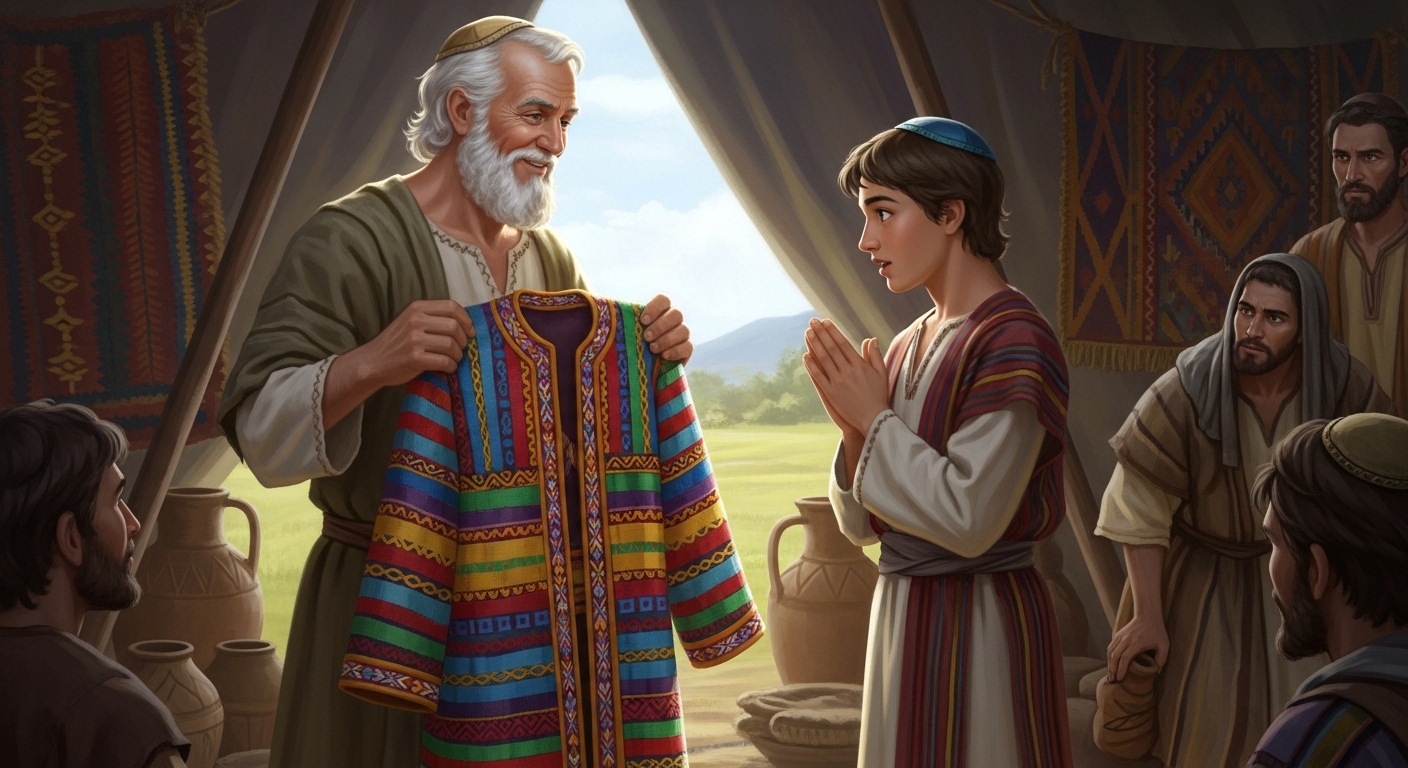
Now Israel loved Joseph more than all his children, because he was the son of his old age: and he made him a coat of many colours.
Even when Joseph was still young, Jacob was already grooming him to lead the family. He spoke of Joseph as the one who would carry the birthright, the one set apart. And then came the coat—a robe woven with many colors, a gift that said without words, “You are my chosen son.”
This coat was a visible symbol of status. It signaled that Joseph, though younger, might receive the birthright. As a result, his brothers “hated him, and could not speak peaceably unto him“.
Genesis 37:4 KJVS
And when his brethren saw that their father loved him more than all his brethren, they hated him, and could not speak peaceably unto him.
Jacob’s family was large and layered. With Leah (his first legal wife), he had six sons—Reuben, Simeon, Levi, Judah, Issachar, and Zebulun. With Rachel (his true love and second legal wife), he had Joseph and Benjamin, the two sons of his deepest love. Through Bilhah, Rachel’s servant, Jacob welcomed two sons—Dan and Naphtali. Through Zilpah, Leah’s servant, came two more sons—Gad and Asher.
In the Old Testament, the “birthright” (the bechorah) traditionally belonged to the firstborn son. It included a double portion of the inheritance, the leadership of the family, and the spiritual headship.
Although Joseph was the eleventh son born to Jacob, he received the birthright for two primary reasons: the disqualification of his older brothers and his status as the firstborn of the favored wife.
Genesis 49:5-7 KJVS
Simeon and Levi are brethren; instruments of cruelty are in their habitations. [6] O my soul, come not thou into their secret; unto their assembly, mine honour, be not thou united: for in their anger they slew a man, and in their selfwill they digged down a wall. [7] Cursed be their anger, for it was fierce; and their wrath, for it was cruel: I will divide them in Jacob, and scatter them in Israel.
1 Chronicles 5:1-2 KJVS
Now the sons of Reuben the firstborn of Israel, (for he was the firstborn; but, forasmuch as he defiled his father’s bed, his birthright was given unto the sons of Joseph the son of Israel: and the genealogy is not to be reckoned after the birthright. [2] For Judah prevailed above his brethren, and of him came the chief ruler; but the birthright was Joseph’s:)
What’s striking is that the birthright in Jacob’s family didn’t land on just one son—it was divided. Joseph received the double portion through his sons, Ephraim and Manasseh, securing his place in the inheritance of the land. Judah, on the other hand, rose to become the family’s leader, the one through whom kings would eventually come. And Levi, though scattered among the tribes, became the spiritual backbone of Israel—the tribe from which the priesthood would emerge.
Levi’s story is especially surprising. They were dispersed much like Simeon, yet they found redemption in a defining moment. When Israel turned to the golden calf, Moses cried out, “Who is on the Lord’s side? let him come unto me.” And it was the sons of Levi who stepped forward. That act of loyalty reshaped their destiny, transforming a scattered tribe into a people set apart for God’s service.
Exodus 32:26 KJVS
Then Moses stood in the gate of the camp, and said, Who is on the LORD’S side? let him come unto me. And all the sons of Levi gathered themselves together unto him.
2. The “Evil Report”
Genesis 37:2 KJVS
These are the generations of Jacob. Joseph, being seventeen years old, was feeding the flock with his brethren; and the lad was with the sons of Bilhah, and with the sons of Zilpah, his father’s wives: and Joseph brought unto his father their evil report.
Joseph served as a shepherd alongside his half-brothers (the sons of Bilhah and Zilpah). However, he acted as an observer for his father.
Joseph wasn’t acting like a gossiping brother—he was carrying the weight of truth. His role in that moment was to be a truth‑bearer, not a talebearer. What he brought to his father wasn’t rumor or spite; it was an honest report about what was really happening.
One mark of true leadership is the courage to stand with the truth—even when it leaves you standing alone, even when it costs you the approval of others. In our Christian walk today, it’s easy to slip into soft, sugar‑coated words that keep everyone comfortable. We avoid saying what’s true because we don’t want to offend, and in the process, we trade honesty for acceptance.
But when we dress up what is wrong to make it sound harmless, we give it room to grow. Evil doesn’t flourish because people shout for it; it flourishes when people whisper politely around it.
3. The Two Prophetic Dreams
Genesis 37:6-8 KJVS
And he said unto them, Hear, I pray you, this dream which I have dreamed: [7] For, behold, we were binding sheaves in the field, and, lo, my sheaf arose, and also stood upright; and, behold, your sheaves stood round about, and made obeisance to my sheaf. [8] And his brethren said to him, Shalt thou indeed reign over us? or shalt thou indeed have dominion over us? And they hated him yet the more for his dreams, and for his words.
In Joseph’s first dream, his brothers didn’t miss the message. They understood exactly what it implied: Joseph was destined to rise above them, to lead, and they would one day fall under his authority. It only deepened their resentment. First came the sting of Jacob giving Joseph the coat of many colors, marking him as favored. Now came a dream—one they instinctively sensed was from God—confirming what they feared most.
Genesis 37:9-11 KJVS
And he dreamed yet another dream, and told it his brethren, and said, Behold, I have dreamed a dream more; and, behold, the sun and the moon and the eleven stars made obeisance to me. [10] And he told it to his father, and to his brethren: and his father rebuked him, and said unto him, What is this dream that thou hast dreamed? Shall I and thy mother and thy brethren indeed come to bow down ourselves to thee to the earth? [11] And his brethren envied him; but his father observed the saying.
Joseph’s second dream didn’t just irritate his brothers—it cut deeper. It stirred envy alongside their hatred, a dangerous mix. In their minds, the dream confirmed what they feared all along: Joseph’s future was already set, and nothing they did could change it. God Himself was establishing Joseph as the one who would one day rescue them.
Jacob’s reaction was more complicated. As a father, the idea of bowing to his own son felt almost unthinkable, so he rebuked Joseph on the surface. But inwardly, he held onto the dream. He watched it. He pondered it. Something in him recognized that God was at work in Joseph’s life, even if he didn’t yet understand how it would unfold.
3. The Mission of No Return
Genesis 37:13-14 KJVS
And Israel said unto Joseph, Do not thy brethren feed the flock in Shechem? come, and I will send thee unto them. And he said to him, Here am I. [14] And he said to him, Go, I pray thee, see whether it be well with thy brethren, and well with the flocks; and bring me word again. So he sent him out of the vale of Hebron, and he came to Shechem.
Jacob sent Joseph to Shechem to check on his brothers and the flocks, to make sure everything was well. But Shechem wasn’t just another stop on the map—it was the very place where Simeon and Levi had slaughtered the men of the Hivites, including their prince and king. Two years had passed, but Jacob likely still feared that the surrounding Canaanites hadn’t forgotten. Sending his sons back there carried real risk.
For Joseph, the memories would have been vivid too. He had seen his brothers return from that massacre with blood on their clothes and plunder in their hands. That kind of violence leaves an imprint. Going back to Shechem may have stirred those memories again—reminding him just how far his brothers were willing to go when anger and vengeance took hold.
Genesis 37:15-20 KJVS
And a certain man found him, and, behold, he was wandering in the field: and the man asked him, saying, What seekest thou? [16] And he said, I seek my brethren: tell me, I pray thee, where they feed their flocks. [17] And the man said, They are departed hence; for I heard them say, Let us go to Dothan. And Joseph went after his brethren, and found them in Dothan. [18] And when they saw him afar off, even before he came near unto them, they conspired against him to slay him. [19] And they said one to another, Behold, this dreamer cometh. [20] Come now therefore, and let us slay him, and cast him into some pit, and we will say, Some evil beast hath devoured him: and we shall see what will become of his dreams.
Fueled by a mix of envy and hatred, Joseph’s brothers convinced themselves that killing him was the only way to stop his dreams from ever coming true. They weren’t just trying to silence the brother they resented—they were unknowingly pushing against the very plan God had prepared for their own future. What they couldn’t see in that moment was that Joseph’s destiny was tied to their survival. God had chosen him to be the one who would one day save them and preserve their nation.
When anger and jealousy take root together, they cloud judgment. You don’t just try to remove the person who stands in your way—you risk destroying the future God intends for you. Joseph’s brothers thought they were eliminating a problem, but in reality, they were striking at the very hope meant to rescue them.
Genesis 37:21-24 KJVS
And Reuben heard it, and he delivered him out of their hands; and said, Let us not kill him. [22] And Reuben said unto them, Shed no blood, but cast him into this pit that is in the wilderness, and lay no hand upon him; that he might rid him out of their hands, to deliver him to his father again. [23] And it came to pass, when Joseph was come unto his brethren, that they stript Joseph out of his coat, his coat of many colours that was on him; [24] And they took him, and cast him into a pit: and the pit was empty, there was no water in it.
God used Reuben to step in and keep his brothers from killing Joseph, but Reuben’s motives weren’t entirely noble. He wasn’t acting out of pure compassion—he was trying to secure something for himself. As the firstborn, he had already lost his place of honor, and he saw Joseph as a chance to redeem his standing. His plan was simple: keep Joseph alive for now, then return later, pull him out of the pit, and bring him safely back to their father.
Genesis 37:29 KJVS
And Reuben returned unto the pit; and, behold, Joseph was not in the pit; and he rent his clothes.
Judah ended up derailing Reuben’s plan by offering a different solution. Instead of killing Joseph outright, he suggested they sell him to the passing Ishmaelites. He framed it as a matter of conscience—better to avoid the guilt of shedding their brother’s blood. But underneath that reasoning was something more practical: if they were going to get rid of Joseph, they might as well gain something from it.
Genesis 37:26-28 KJVS
And Judah said unto his brethren, What profit is it if we slay our brother, and conceal his blood? [27] Come, and let us sell him to the Ishmeelites, and let not our hand be upon him; for he is our brother and our flesh. And his brethren were content. [28] Then there passed by Midianites merchantmen; and they drew and lifted up Joseph out of the pit, and sold Joseph to the Ishmeelites for twenty pieces of silver: and they brought Joseph into Egypt.
This choice would come back to haunt Joseph’s brothers twenty‑two years later. In the quiet moments, they would hear again the sound of Joseph pleading with them, begging not to be sold. They would remember his cries fading as he was dragged away in chains by their own relatives, the Ishmaelites. Those memories—his voice, his fear, his desperation—would echo in their hearts long after the moment had passed.
4. Jacob’s Anguish
Genesis 37:31-34 KJVS
And they took Joseph’s coat, and killed a kid of the goats, and dipped the coat in the blood; [32] And they sent the coat of many colours, and they brought it to their father; and said, This have we found: know now whether it be thy son’s coat or no. [33] And he knew it, and said, It is my son’s coat; an evil beast hath devoured him; Joseph is without doubt rent in pieces. [34] And Jacob rent his clothes, and put sackcloth upon his loins, and mourned for his son many days.
When Jacob heard what had happened to Joseph, his grief ran deep. He mourned for many days, but his sorrow wasn’t only for the son he loved most. Beneath the tears was a father’s fear. Joseph had been the one he envisioned carrying the family forward, the one prepared for leadership. Now he was gone.
Benjamin was still just a small child—barely a year old—and Jacob had no way of knowing if he would live long enough to grow into the blessing meant for him. And Jacob himself felt the weight of age pressing in. He didn’t know if he would still be alive when Benjamin reached maturity. So his mourning was layered: grief for Joseph, fear for Benjamin, and a deep worry about the future of the family God had entrusted to him.
God’s Working
Through everything that unfolded in Joseph’s life, we begin to see a truth that often plays out in our own stories: God’s plan doesn’t blend with ours. Joseph may have imagined his future through the lens of his father’s guidance—being shaped, favored, and prepared to lead the family. Under Jacob’s care, he could have become a capable leader, but he would never have become a deliverer.
God had something far greater in mind. His plan was to form Joseph into a leader of extraordinary strength, wisdom, and resilience—a man who would one day save an entire nation, including the very brothers who betrayed him. But that kind of leader couldn’t be shaped in the comfort of his father’s tent. God would use the hardships still ahead to forge Joseph’s character, to teach him tenacity, humility, and trust.
One day, Joseph would look back and understand. What felt like loss, betrayal, and detours were actually the very tools God used to bring about good. “God meant it for good…“
To be continued.
Thank you for taking the time to read this. God is faithful! God bless you.

Leave a Reply