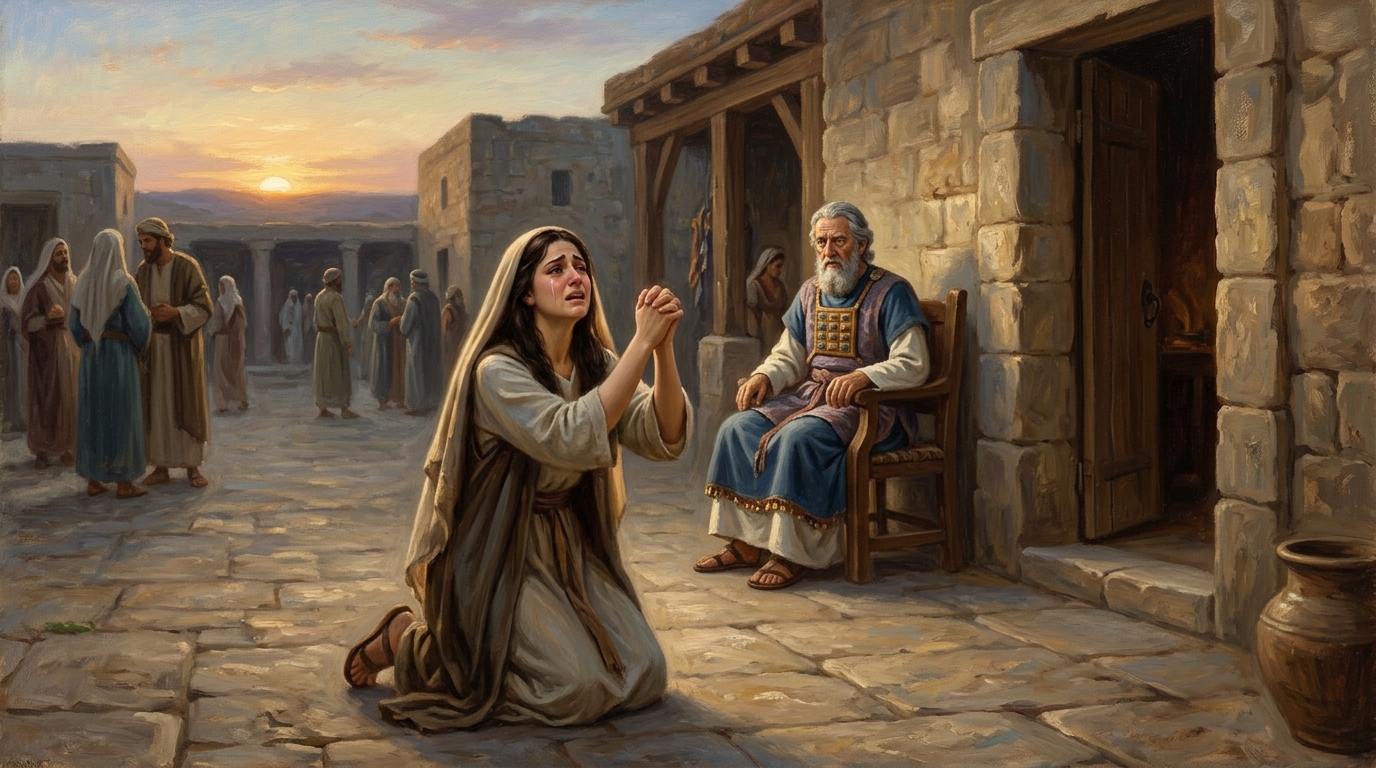
1 Samuel 1:9-11 KJVS
So Hannah rose up after they had eaten in Shiloh, and after they had drunk. Now Eli the priest sat upon a seat by a post of the temple of the LORD. [10] And she was in bitterness of soul, and prayed unto the LORD, and wept sore. [11] And she vowed a vow, and said, O LORD of hosts, if thou wilt indeed look on the affliction of thine handmaid, and remember me, and not forget thine handmaid, but wilt give unto thine handmaid a man child, then I will give him unto the LORD all the days of his life, and there shall no razor come upon his head.
To begin a study of Hannah’s prayer, we must first look at the “soil” from which this prayer grew. We see a woman who was “of a sorrowful spirit,” dealing with the bitterness of barrenness and the provocation of here rival, Peninnah.
The Preparation of the Soil
Hannah’s prayer isn’t just a thank-you whispered over her long-awaited son, Samuel. It’s a sweeping, soul-deep declaration about who God is and how He moves. Her words become a turning point in Scripture—a hinge that swings Israel out or the chaos of the Judges and into the dawn of the Kings.
What began as heartbreak became the soil where hope quietly took root. Her tears watered the ground of her faith. Her persistent prayer became the fertilizer that kept her trust alive. And though the answer seemed delayed, it wasn’t denial—it was timing. Like the Chinese bamboo that hides its growth underground for years, Hannah’s miracle was stretching, strengthening, preparing… until the moment it finally broke through the surface.

1. The Conflict
1 Samuel 1:4-7 KJVS
And when the time was that Elkanah offered, he gave to Peninnah his wife, and to all her sons and her daughters, portions: [5] But unto Hannah he gave a worthy portion; for he loved Hannah: but the LORD had shut up her womb. [6] And her adversary also provoked her sore, for to make her fret, because the LORD had shut up her womb. [7] And as he did so year by year, when she went up to the house of the LORD, so she provoked her; therefore she wept, and did not eat.
The friction between Hannah and Peninnah feels like a haunting echo of Rachel and Leah. It’s that same, familiar ache: one woman is deeply loved but feels “empty,” while the other is “fruitful” but feels second-best. For Hannah and Rachel, the closed womb wasn’t just a medical fact; it was a quiet, heavy grief they carried into every room.

Hannah’s struggle wasn’t just about a nursery she couldn’t fill—it was the daily, sharp sting of Peninnah’s reminders. Imagine the dinner table: Elkanah gives Hannah the best portion because his heart breaks for her, yet Peninnah is the one surrounded by the noise of children Hannah was desperate to hear. It’s the crushing weight of seeing someone you dislike walk easily into the very blessing you’ve been begging God for. It’s that universal human sting: being “loved” by people, yet feeling completely forgotten by God.
2. The Thesis
1 Samuel 1:10-11 KJVS
And she was in bitterness of soul, and prayed unto the LORD, and wept sore. [11] And she vowed a vow, and said, O LORD of hosts, if thou wilt indeed look on the affliction of thine handmaid, and remember me, and not forget thine handmaid, but wilt give unto thine handmaid a man child, then I will give him unto the LORD all the days of his life, and there shall no razor come upon his head.
Hannah wasn’t simply asking God for a child; she was offering something far deeper. Hannah promised that if God gave her a son, she would return him—not as an ordinary child, but as one set apart, consecrated for God’s purposes. Samuel wouldn’t just serve in the temple, he would grow into a Judge of Israel, a life shaped entirely around God’s calling.

And he wouldn’t be a Nazirite in the usual sense. His whole existence would belong to God—marked, claimed, and carried by the Spirit for all his days. Samuel would become like a banner lifted high over a building, quietly declaring who the true Owner of that life and territory is.
Because Hannah released her claim on him—because she let go of what she longed for most—Samuel became a place where God’s presence could dwell without interruption. Her surrender opened a lifelong space for God’s presence could dwell without interruption.
The Breaking Point: Emptying the Vessel
The silence of Hannah in her prayer was striking. It wasn’t the quiet of someone who had run out of words; it was the quiet of someone whose heart had been speaking long before her lips ever could. Her wordlessness wasn’t a small narrative detail—it was the echo of her brokenness, the shape her longing took when language failed her. In that trembling silence, you can almost hear the weight she carried and the stubborn, flickering hope she refused to let go of. Her stillness becomes its own kind of testimony, a sign of a spirit that is bruised yet unyielding, emptied yet still reaching for God in the only way she could.
1. The Silence of Surrender
1 Samuel 1:12-16 KJVS
And it came to pass, as she continued praying before the LORD, that Eli marked her mouth. [13] Now Hannah, she spake in her heart; only her lips moved, but her voice was not heard: therefore Eli thought she had been drunken. [14] And Eli said unto her, How long wilt thou be drunken? put away thy wine from thee. [15] And Hannah answered and said, No, my lord, I am a woman of a sorrowful spirit: I have drunk neither wine nor strong drink, but have poured out my soul before the LORD. [16] Count not thine handmaid for a daughter of Belial: for out of the abundance of my complaint and grief have I spoken hitherto.

Sometimes the grief are so heavy that the lungs simply cannot find the air to project it. Hannah was in such “bitterness of soul” that her prayer moved past the level of vocabulary and into the level of groaning. In that time of prayer in the house of the Lord, prayer was often corporate and audible. By praying silently, Hannah was withdrawing from the “noise” of the religious ritual around her to have a direct, heart-to-heart transaction with God. She didn’t need Eli the priest to hear her; she needed the God of the Priest to hear her.
Because her voice was not heard, Eli thought she was “drunken.” The world often mistakes deep spiritual travail for madness or intoxication. Eli saw the lips moving but couldn’t hear the heart speaking. It teaches us that true prayer is not about volume; it’s about weight. God is a God of knowledge who hears the “voice” of the heart even when the throat is paralyzed by grief.
1 Samuel 1:17-19 KJVS
Then Eli answered and said, Go in peace: and the God of Israel grant thee thy petition that thou hast asked of him. [18] And she said, Let thine handmaid find grace in thy sight. So the woman went her way, and did eat, and her countenance was no more sad. [19] And they rose up in the morning early, and worshipped before the LORD, and returned, and came to their house to Ramah: and Elkanah knew Hannah his wife; and the LORD remembered her.
When the misunderstanding finally cleared and Eli saw the raw, trembling honesty of Hannah’s heart, his rebuke turned into a blessing. He gave her more than just a kind word; he gave her the assurance that her silence hadn’t been an obstacle—that God had captured every unspoken syllable and every jagged breath of her prayer.
The shift in Hannah was almost physical. She didn’t wait for a positive pregnancy test to find joy; she found it in the promise. Hannah walked away with a soul as quiet and settled as the sea of Galilee after Christ spoke those three sovereign words: “Peace, be still.” The storm of Peninnah’s voice and her own internal grief simply lost their power to shake her. She went home, sat down to eat, and truly enjoyed the company of her husband again, because her heart was no longer starving for a miracle—it was full of God.

And then comes the phrase that serves as the heartbeat of the whole story: “the LORD remembered her.” It’s a beautiful reminder that God’s “remembering” isn’t about Him recovering a lost thought; it’s about Him moving into action or our behalf. He had never lost sight of her in the dust.
2. The Weight of Joy
1 Samuel 1:20 KJVS
Wherefore it came to pass, when the time was come about after Hannah had conceived, that she bare a son, and called his name Samuel, saying, Because I have asked him of the LORD.

The long, grueling years of weeping and the relentless “sting” of conflict didn’t just fade; they were swallowed up by a miracle. The very moment Hannah held Samuel, the echoes of Peninnah’s insults and the hollow ache of those empty years seemed to vanish into the background. It was as if a heavy, winter fog had finally lifted, replaced by the warmth of a long-awaited sun.
The “travail“—that bone-deep exhaustion of soul—was forgotten in the weight of the child in her arms. That vessel, which had been scoured clean by surrender and emptied by grief, wasn’t just occupied; it was overflowing with a joy that only comes after a long night of waiting.
1 Samuel 1:21-23 KJVS
And the man Elkanah, and all his house, went up to offer unto the LORD the yearly sacrifice, and his vow. [22] But Hannah went not up; for she said unto her husband, I will not go up until the child be weaned, and then I will bring him, that he may appear before the LORD, and there abide for ever. [23] And Elkanah her husband said unto her, Do what seemeth thee good; tarry until thou have weaned him; only the LORD establish his word. So the woman abode, and gave her son suck until she weaned him.
When the year finally came for the family to make their annual journey to the Tabernacle, Hannah made a choice that seems quiet but was actually profoundly radical. While the rest of the household prepared for the public ceremony of the yearly sacrifice, Hannah stayed behind to tend to her own “personal sacrifice.“
You see, she hadn’t forgotten the promise she made in the shadow of her tears. She had told God that if He gave her a son, she would give him back for a lifetime. Samuel was a Nazirite—a living, breathing vow. And Hannah knew that those first three years, the “weaning years,” were her only window of time. It was sacred, fleeting opportunity to pour her heart, her faith, and her testimony into him before placing his hand into Eli’s.
Imagine the sheer strength of will that took. Hannah had waited years—likely far longer than the tree years she would actually get to keep him—for this child. Samuel was her answered prayer, the physical evidence of God’s favor. Yet, she didn’t allow the gift to eclipse the Giver. She wasn’t overcome by the joy of the “answered prayer” to the point of forgetting the Promise-Maker. Hannah sat in those quiet years at home, not as someone skipping out on worship, but as someone preparing the most “perfect sacrifice” a mother could ever offer. She was readying herself to let go before she had even fully settled into holding on.
1 Samuel 1:24-28 KJVS
And when she had weaned him, she took him up with her, with three bullocks, and one ephah of flour, and a bottle of wine, and brought him unto the house of the LORD in Shiloh: and the child was young. [25] And they slew a bullock, and brought the child to Eli. [26] And she said, Oh my lord, as thy soul liveth, my lord, I am the woman that stood by thee here, praying unto the LORD. [27] For this child I prayed; and the LORD hath given me my petition which I asked of him: [28] Therefore also I have lent him to the LORD; as long as he liveth he shall be lent to the LORD. And he worshipped the LORD there.
After three years of holding him close, the time had finally come. Samuel was ready—but perhaps more importantly, Hannah was ready. As she made the trek back to the Tabernacle, she wasn’t just “dropping off” her son; she was approaching the altar to formally redeem a vow she had made in the depths of her despair. She didn’t come empty-handed, either. In keeping with the “full measure” of God’s requirements in Numbers 15, she brought a substantial offering of bullocks, flour, and wine. It was her way of saying, “Lord, I am not giving You what is leftover or what is easy; I am giving You everything.”
The layers of her sacrifice were deeply personal. The bullocks served as a Burnt Offering—a raw, powerful symbol of total consecration. By laying them down, she was physically demonstrating that Samuel’s life didn’t belong to her; it belonged entirely to God. The flour (the Meat Offering) represented her daily sustenance and the fruit of her hard labor, while the wine (the Drink Offering) was poured out as a symbol of joy. It was the Old Testament version of a “cheerful giver“—a heart so full of gratitude that it “pours itself out” without holding back.

This moment proves that true surrender is undeniably expensive. It cost Hannah her only son, her material resources, and the future comfort of having her child by her side. Yet, because she had built her life on the Rock, she didn’t view this as a “loss.” She viewed it as a holy investment. She was “sowing” Samuel into the house of the LORD, confident that the “God of knowledge” was weighing her heart and would take her sacrifice to light a fire that would save a nation.
Building on the Rock
1 Samuel 2:1-2 KJVS
And Hannah prayed, and said, My heart rejoiceth in the LORD, mine horn is exalted in the LORD: my mouth is enlarged over mine enemies; because I rejoice in thy salvation. [2] There is none holy as the LORD: for there is none beside thee: neither is there any rock like our God.
Hannah’s prayer shifts from a private plea to a public anthem. After years of being “shaken” by Peninnah’s provocation and her own barrenness, she finally finds her footing.
1. The Geometry of the Rock: Unchanging and Immovable

In the ancient world, a “Rock” (Tsur) wasn’t just a stone; it was a fortress or a high cliff. For Hannah, Peninnah was like the shifting sand—constantly moving, unpredictable, and abrasive. Elkanah’s favor was like a tent—kind and sheltering, but easily torn by life’s circumstances. By calling God here Rock, Hannah is saying that she has moved her “house” from shifting sands of human opinion and biological success onto a foundation that cannot be move.
Imagine a lighthouse built on a massive stone cliff, The waves crash against it, and the salt spray stings, but the lighthouse stands firm because the rock beneath it doesn’t budge. Hannah found that Rock in the middle of her “bitterness of soul.“
Building on the “sandy foundation” is like trying to anchor a ship in a pile of salt—the moment the tide of life rises, the ground beneath you simply dissolves. It is full of danger because it relies on shifting circumstances: human favor, physical health, or financial status.
In contrast, Hannah’s discovery of the Rock corresponds perfectly to the New Testament’s “Chief Cornerstone.” In the Scripture, a rock isn’t just a material; it is a title for God’s unchanging nature. By building her identity on this Rock, Hannah was able to support the “weight” of her eventual leadership role as the mother of a prophet.
2. Exaltation of the Horn
Hannah says, “mine horn is exalted in the LORD.” In the Scripture, the “horn” symbolizes strength and dignity.
- Her Human Struggle: For years, Hannah’s “horn” was in the dust, she felt low, insignificant, and pushed aside.
- The Divine Reversal: When she found her stability in the Rock, God lifted her head.
Think of a “wobble toy” with a heavy weight at the bottom. You can push it, knock it over, or flick it, but it always snaps back to an upright position. Why? Because its center of gravity is at the very base. Hannah’s “center of gravity” was no longer her womb or her social status; it was the holiness of God. Because her weight was in the Rock, she could be “pushed” by her adversary but she could no longer be “toppled.”
3. The Uniqueness of the Foundation
Hannah emphasizes, “neither is there any rock like our God.” She had tried other “rocks.”
- The Rock of Human Love: Elkanah’s “worthy portion” couldn’t stop her tears.
- The Rock of Religion: Going to the tabernacle year after year didn’t initially change her heart until she met God personally in that silent prayer.
She discovered that every other foundation eventually crumbles. Only the holiness of God provides a stability that is independent of our “fruitfulness.”
The Reversal of Fortune
1 Samuel 2:3 KJVS
Talk no more so exceeding proudly; let not arrogancy come out of your mouth: for the LORD is a God of knowledge, and by him actions are weighed.
Hannah makes a bold claim about how God sees the world compared to how humans see it. This leads directly into her description of God flipping the world’s script: the bows of the mighty are broken, while those who stumbled are “girded with strength.” She uses a beautiful analogy: God weighs actions. While Peninnah was measuring success by the number of her children, God was weighing the hearts of both women.
1 Samuel 2:8 KJVS
He raiseth up the poor out of the dust, and lifteth up the beggar from the dunghill, to set them among princes, and to make them inherit the throne of glory: for the pillars of the earth are the LORD’S, and he hath set the world upon them.
Hannah’s prayer suggests that God doesn’t just “clean” us to keep us as ornaments; He cleans us so we can be useful. She says the “pillars of the earth are the LORD’s” and He sets the world upon them. This implies that once we are lifted, we become part of His supporting structure in the world.
We are reminded that we are “the light of the world,” and to pull others out of the fire. Hannah’s testimony did exactly this. Her personal victory wasn’t just for her; it provided the “light” that led to the birth of Samuel, who would eventually lead the entire nation back to God. When we are lifted from our own “dunghill,” our transformed life becomes a living bridge for others to cross.
1 Samuel 2:10 KJVS
The adversaries of the LORD shall be broken to pieces; out of heaven shall he thunder upon them: the LORD shall judge the ends of the earth; and he shall give strength unto his king, and exalt the horn of his anointed.
Hannah ends her prayer with a very specific prophetic word. This is the first time in the Bible the word “Anointed” is used in this way. Hannah realizes that her story is actually part of a much bigger story—the story of Christ.
When Hannah gave Samuel back to the LORD, she was acknowledging that the “provision” she received was actually a “stewardship.” By placing him in the Tabernacle, she turned her answered prayer into an answer for all of Israel’s prayers for leadership and guidance.
Conclusion: From the Dunghill to the Kingdom
Hannah’s journey reminds us that our “breaking point” is often the very place where God begins His greatest work of restoration. We see a woman who moved from the “bitterness of soul” to a state of total surrender, allowing the Lord to lift her from the “dust” and set her among princes.
But as Hannah’s life demonstrates, this divine lifting is never for our benefit alone; God fills us so that we might become a light to those still seeking His power. Just as Hannah surrendered Samuel to fulfill a calling that would save a nation, God provides for us so that we can become the answered prayer for others in the same “dunghill” we once occupied. Our testimony is the bridge—pulled from fire ourselves, we now stand ready to reach back and pull others into the glorious light of His presence.
Thank you for taking the time to read this. God is faithful! God bless you.

Leave a Reply