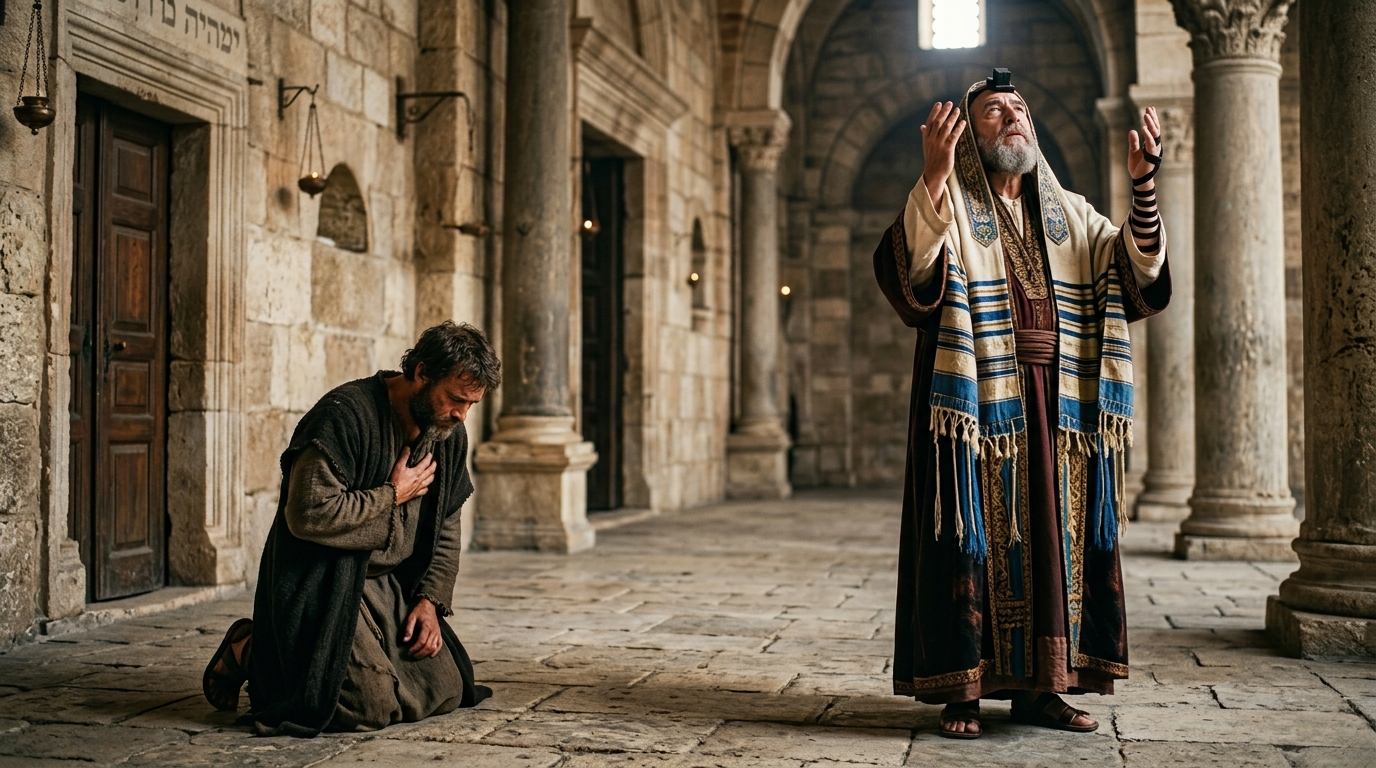
Luke 18:9-10 KJVS
And he spake this parable unto certain which trusted in themselves that they were righteous, and despised others: [10] Two men went up into the temple to pray; the one a Pharisee, and the other a publican.
It is truly remarkable to read how the Master Teacher, the Lord Jesus Christ, layers His lessons. He doesn’t just stop at one story; He stacks them like building blocks. Right on the heels of the Persistent Widow, He introduces the Pharisee and the Publican.
It’s as if He is painting a complete portrait of the soul in conversation with God. In the first parable, He gives us a lesson in persistence—the “never-give-up” grit of the widow. In the second, He shifts the focus to positioning—the “heart-on-the-floor” humility of the tax collector.
It’s Not Only About Power
It’s profound how the Lord Jesus ends the story of the Persistent Widow with a haunting, open-ended question: “Nevertheless when the Son of man cometh, shall he find faith in the earth?” It’s a question that hangs in the air like an unfinished symphony, leaving us to wonder what that kind of “end-times faith” actually looks like.
Luke 18:8-9 KJVS
I tell you that he will avenge them speedily. Nevertheless when the Son of man cometh, shall he find faith on the earth? [9] And he spake this parable unto certain which trusted in themselves that they were righteous, and despised others:
But the beauty of the Mater’s teaching is that He doesn’t leave us guessing. He immediately picks up the brush again and paints the answer in the very next breathe with the story of the Pharisee and Publican.
The answer to His question is a resounding “Yes“—but that faith isn’t found in the self-assured “performance” of the religious elite. It’s found in the raw, honest “positioning” of a heart that knows its own need.
1. The Signal and the Antenna
This brings back such a vivid memory of the “analog days.” I can still see myself climbing up onto the roof, hands on that cold metal pole, twisting the antenna an inch at a time while someone downstairs shouted through the window, “Wait! Go back! We almost had it!“

Every time we wanted to change the channel, someone had to make that trek back up to the roof. You could have the best TV in the neighborhood, but if that antenna wasn’t dialed in perfectly, all you’d get was a screen full of static. To see the picture clearly, you needed two things: reception and right positioning.
- Signal Strength: The Persistent Widow – She represents the power and the volume. She refuses to let the frequency go dead, she keeps broadcasting her plea until it breaks through the noise of an unjust world
- Antenna Alignment: The Publican – You can have the strongest signal in the world (persistence), but if you antenna is pointed toward your own ego, you won’t catch the “heavenly download.” The Pharisee was broadcasting to himself, but the Publican aimed his brokenness toward the Father.
2. The “Two-Part” Prayer
In our daily lives and our service to the Lord, we often get one half right while neglecting the other.
- The Widows Drive: We might have her persistency, knocking on doors until our knuckles bleed, but we do it with the Pharisee’s heart, thinking we deserve the opening because of our hard work.
- The Publican’s Humility: We need to be humble, feeling our need deeply, but we lack the Widow’s tenacity to keep asking when the answer doesn’t come in the first “sprint.”
We want to be strong like the Widow in our consistency, but “publican-pure” in our character.
Luke 18:14 KJVS
I tell you, this man went down to his house justified rather than the other: for every one that exalteth himself shall be abased; and he that humbleth himself shall be exalted.
Architecture of the Status
Luke 18:11-13 KJVS
The Pharisee stood and prayed thus with himself, God, I thank thee, that I am not as other men are, extortioners, unjust, adulterers, or even as this publican. [12] I fast twice in the week, I give tithes of all that I possess. [13] And the publican, standing afar off, would not lift up so much as his eyes unto heaven, but smote upon his breast, saying, God be merciful to me a sinner.
To understand the setting of the Publican and the Pharisee, we have to look at the temple in Jerusalem not just as a building, but as a massive, bustling “Corporate Headquarters” for the soul. In the text it says the “went up into the temple to pray.” This wasn’t a quiet, empty chapel; it was a sensory-overload experience of smoke, chanting, and strict architectural boundaries.
It’s easy to imagine the Temple as a place where people just drifted in and out whenever they felt like it, but it was actually much more synchronized than that. Most people timed their visit for the “Tamid“—the morning and evening sacrifice.
When those silver trumpets sounded at 9:00 AM and 3:00 PM, the whole city paused. Both the Pharisee and the Publican didn’t just happen to be there; they both showed up on time, showing a level of discipline and devotion that we often overlook.
1. The Geometry of Status
The Temple was designed with access levels, like a complex database:

- The Court of the Gentiles: The “Public Domain” where anyone could go.
- The Court of the Women: Where the furthest point women could enter to worship.
- The Court of Israel: Only for Jewish men, where the Pharisee and Publican entered to pray.
- The Court of Priests: Where the sacrifices actually happened.
It is fascinating to picture the physical “map” of their hearts through the distance they chose to stand from the Holy of Holies.
The Pharisee likely marched right up to the very edge of the court, perhaps standing as close to the heavy, ornate veil as his credentials allowed. He stood tall, his prayer less of a conversation and more of a “press release,” lifting himself up on a pedestal built from the bricks of other people’s failures.
Meanwhile, the Publican likely lingered back by the massive stone wall that separated the Court of Israel from the Court of the Women. You can almost see him hesitating at the threshold, caught in that painful internal tug-of-war. He’s stuck between the desperate need to be near God and the crushing weight of his own guilt, wondering if he even has the right to step “inside” or if he should just stay out in the hallway.
2. The Physicality: The User Interface of Prayer
In that era, prayer wasn’t just a silent thought, it was a physical “interface.”
- Standing: The standard posture for prayer was standing, it was synchronized with the Morning and Evening sacrifices. When the smoke of the burnt offering ascended, it was the “signal” for the people to begin their own petitions.
- The Orans Posture: People usually prayed with their hands lifted toward heaven, palms up, as if waiting to receive a delivery.
- Looking Up: It was standard to look toward the sky.

While there were formal prayers (like Shema or the Amidah), the Temple was also a place for raw, individual desperation—like the “Persistent Widow” or Hannah. For the person in Jesus’ time, the Temple wasn’t just a building; it was the earth’s anchor. They believed that as long as the prayers and sacrifices continued in the Temple, the world would remain stable. When they prayed there, they weren’t just asking for personal help; they were “leaning” their weigh against the very center of the universe: God.
This is why the Publican’s behavior was so shocking to the onlookers. He broke the “standard UI.” He would not lift up so much as his eyes unto heaven and he smote upon his breast. In a place everyone was trying to look official, he looked broken.
3. Finding Your “Temple”
Even though we don’t go to a physical stone building in Jerusalem anymore, we still have “Courts” in our hearts.
When you enter your “prayer time,” do you find yourself drifting toward the “Court of Israel“—trying to prove your status and credentials to God? Maybe you need to try to stand in the “Back Row” of our heart. Like the Publican, don’t worry about the performance of the lifting of hands. Focus on the smiting of the breast—the honest admission that we need the Master to fix what we cannot.
The Brand Identity
Luke 18:10-14 KJVS
Two men went up into the temple to pray; the one a Pharisee, and the other a publican. [11] The Pharisee stood and prayed thus with himself, God, I thank thee, that I am not as other men are, extortioners, unjust, adulterers, or even as this publican. [12] I fast twice in the week, I give tithes of all that I possess. [13] And the publican, standing afar off, would not lift up so much as his eyes unto heaven, but smote upon his breast, saying, God be merciful to me a sinner. [14] I tell you, this man went down to his house justified rather than the other: for every one that exalteth himself shall be abased; and he that humbleth himself shall be exalted.

To grasp the clash between the Pharisee and the Publican, we have to look at the “Brand Identity” each man presented at the altar. Using a modern analogy like programming, this wasn’t just a change in the user interface or the words they spoke; it was a fundamental difference in their “Source Code.”
1. The Pitch
The Pharisee steps forward like a man presenting a polished resume, laying our every shiny accomplishment as if he’s trying to convince the Judge that he’s earned a prize. The Publican comes with nothing to sell—no brochure, no pitch—just a trembling request to be seen, to be heard, to be shown mercy.
Both stand before the same Almighty God, both speak, both make their case. But only one voice rises above the noise of self-promotion and reaches the heart of Heaven.
- The Pharisee: When we “thank God” that we aren’t like “those people” (the addicts, the dishonest, the “un-woke”), we are actually pitching our own resume.
- The Publican: Real prayer begins when we stop looking at our neighbor’s “rap sheet” and start looking at our own pulse. The application here is to start your day not by listing your virtues, but by acknowledging your need for air.
2. The Strategy
The Pharisee is practicing “Relative Excellence.” It’s like a student who is happy with a D-minus just because the person next to them got an F. The Publican is practicing “Internal Auditing.” He isn’t looking at the other student; he’s looking at the Answer Key (God’s Holiness) and realizing he hasn’t even written his name correctly on the paper.
Next time you feel “good” about your spiritual life, ask yourself: Am I comparing myself to a crooked world, or to a Holy God? Validation through disparaging others is a “brand” that fails the moment you stand before the Truth. True strategy is a “heart audit“—finding the debt so you can finally ask for the bailout.
3. The Posture
Think of a theater. The Pharisee takes “Center Stage,” standing under the spotlight, praying “with himself.” He is his own audience. The Publican is in the Back Row, standing “afar off” in the shadows. He isn’t there to be seen; he is there because he must be there, yet he feels the weight of the atmosphere is too heavy for his eyes to meet the ceiling.
- Centralized bs. Decentralized: When we “centralized” our ego, God becomes a backup singer in the play of our lives.
- Practical Move: “Afar off” means acknowledging the gap between who we are and who God is. It’s the difference between walking into a room like you own it and walking into a room like you’re honored to be invited. Try “decentralizing” your prayers today—make God the subject of every sentence rather than the object of your requests.
Checking Your “System Log”
We often try to “rebrand” our lives by changing our external behavior, but we leave the internal logic untouched.
- Pharisee Mode: This is when you “debug” your life by comparing your code to someone else’s. You feel like a “Premium Version” of a human being because you haven’t crashed as publicly as the person next to you.
- Publican Mode: This is hitting the “Reset to Factory Settings” button. It’s admitting that your core logic is flawed and you need an entirely new Operating System.
Today, don’t just “patch” a bad habit to look better for the “users” around you. Go to the Altar and submit a full Bug Report to God. When you admit your “Source Code” is broken, He doesn’t delete the program—He rewrites it with His own Grace.
Thank you for taking the time to read this. God is faithful! God bless you.

Leave a Reply