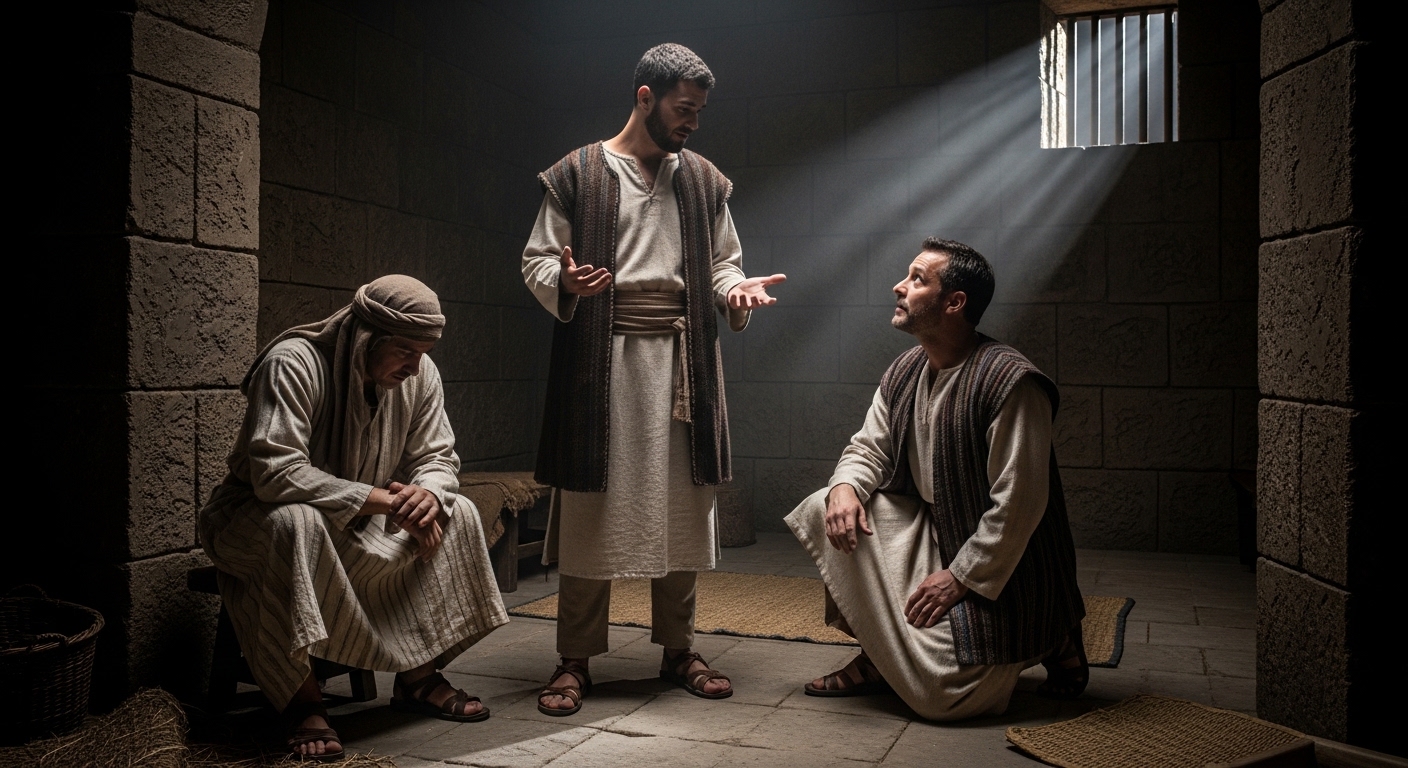
Genesis 40:1-4 KJVS
And it came to pass after these things, that the butler of the king of Egypt and his baker had offended their lord the king of Egypt. [2] And Pharaoh was wroth against two of his officers, against the chief of the butlers, and against the chief of the bakers. [3] And he put them in ward in the house of the captain of the guard, into the prison, the place where Joseph was bound. [4] And the captain of the guard charged Joseph with them, and he served them: and they continued a season in ward.
Joseph’s time in prison wasn’t wasted—it was a season of divine waiting. What looked like a setback was actually a sacred classroom. In that hidden place, God was shaping him, refining him, and preparing him for a role far greater than anything he had known. Joseph entered prison as a faithful servant, but he would emerge as a man entrusted with interpreting dreams and influencing nations.
When you trace the timeline, the weight of his journey becomes even clearer. From the moment he was sold into slavery to the day he stood before Pharaoh, about thirteen long years passed. Roughly ten of those years were spent serving in Potiphar’s house, and around three were spent in the confines of the royal prison. These weren’t short seasons—they were years of endurance, faithfulness, and unseen growth.
Yet through every year, every disappointment, and every dark corner of that prison, God was quietly shaping Joseph into the man who would one day save Egypt—and his own family—from famine. What looked like confinement was actually preparation. What felt like delay was divine timing. And what seemed like the end of Joseph’s story was only the beginning of God’s greater plan.
From Dreamer to Interpreter of Dreams
When Joseph first entered the prison, God was already preparing the next step of his journey. Two significant prisoners were placed under his care—the chief cupbearer and the chief baker. Pharaoh had become furious with them, and as a result, they were thrown into the royal prison, waiting anxiously for whatever judgment might come next. Their arrival wasn’t accidental; they were divinely positioned to intersect with Joseph’s story at just the right moment.
1. Serving the Inmates
Genesis 40:4 KJVS
And the captain of the guard charged Joseph with them, and he served them: and they continued a season in ward.
One of the most striking things about Joseph is that his commitment to serve never wavered. His circumstances changed—sometimes violently, sometimes unfairly—but his posture didn’t. As a young man in his father’s house, he served with the eagerness of someone who still believed the world was full of promise. In Potiphar’s palace, he served with excellence, even when he was far from home and carrying wounds no one could see. And in prison—perhaps the darkest chapter of his life—he still served. Not because anyone rewarded him, and not because the environment was inspiring, but because service had become the core of who he was.
Joseph understood something most people only learn through pain: that God’s calling isn’t suspended when life gets difficult. He knew that wherever he found himself—whether in a robe of many colors, a slave’s tunic, or a prisoner’s chains—his primary assignment from God remained the same: to serve others with integrity, compassion, and faithfulness.
And that’s where the truest strength of a leader is revealed. Not in titles, not in platforms, not in moments of applause, but in the quiet, consistent willingness to serve. Joseph’s greatness wasn’t forged in the palace; it was proven in the places no one wanted to be. His leadership grew in the soil of humility, in the daily choice to bless others even when his own life felt broken.
That is the kind of character God shapes in those He intends to elevate—leaders who understand that serving others is not a step toward greatness; it is greatness.
2. Seeing the Inner Sadness
Genesis 40:5-6 KJVS
And they dreamed a dream both of them, each man his dream in one night, each man according to the interpretation of his dream, the butler and the baker of the king of Egypt, which were bound in the prison. [6] And Joseph came in unto them in the morning, and looked upon them, and, behold, they were sad.
Another remarkable trait Joseph carried was his ability to sense when something wasn’t right around him. He didn’t just manage tasks; he paid attention to people. Even in the dim, heavy atmosphere of the prison, he noticed shifts in tone, changes in posture, the quiet heaviness that settles on someone’s face when their spirit is troubled. Joseph had a kind of inner radar—a God‑shaped instinct—that alerted him when the people under his care were hurting.
He didn’t ignore those signals or brush them aside. He leaned in. He asked questions. He cared enough to notice what others might have overlooked. That sensitivity wasn’t weakness; it was leadership. It showed that Joseph wasn’t just responsible for their duties—he was responsible for their hearts.
In a place where most people were focused on their own survival, Joseph carried a different spirit. He saw people’s pain before they spoke it. He recognized when something was off long before anyone explained. And that awareness, that compassionate instinct, became one of the quiet ways God used him to bring hope into a hopeless place.
3. Joseph the Dreamsmith
Genesis 40:7-11 KJVS
And he asked Pharaoh’s officers that were with him in the ward of his lord’s house, saying, Wherefore look ye so sadly to day? [8] And they said unto him, We have dreamed a dream, and there is no interpreter of it. And Joseph said unto them, Do not interpretations belong to God? tell me them, I pray you. [9] And the chief butler told his dream to Joseph, and said to him, In my dream, behold, a vine was before me; [10] And in the vine were three branches: and it was as though it budded, and her blossoms shot forth; and the clusters thereof brought forth ripe grapes: [11] And Pharaoh’s cup was in my hand: and I took the grapes, and pressed them into Pharaoh’s cup, and I gave the cup into Pharaoh’s hand.
That morning, the atmosphere in the prison felt heavier than usual. The two inmates who shared Joseph’s confinement carried a troubled look, the kind that lingers after a night of unsettling dreams. Joseph noticed immediately—he had learned to read people’s faces long before he ever learned to interpret dreams.
Gently, he asked them why they looked so distressed. They hesitated at first, unsure whether to trust him with something so personal. But Joseph’s presence had a way of softening defenses. He wasn’t just another prisoner; there was a steadiness in him, a quiet confidence that made people feel seen.
When he said, “Do not interpretations belong to God?” something shifted in them. Maybe they were religious men, or maybe they simply recognized sincerity when they heard it. Either way, the mention of God didn’t push them away—it opened them. It reminded them that their dreams might carry meaning, and that Joseph wasn’t claiming power for himself; he was pointing beyond himself.
The chief butler was the first to lean in. Joseph’s calm assurance gave him courage, and once he felt that trust settle in his chest, the words came quickly. He began to tell his dream—not just the images, but the fear behind them, the confusion, the hope that maybe, just maybe, someone could help him understand what it all meant.
And Joseph listened, not as a judge or a mystic, but as a man who believed that God still spoke in the quiet places of the night.
Genesis 40:12-15 KJVS
And Joseph said unto him, This is the interpretation of it: The three branches are three days: [13] Yet within three days shall Pharaoh lift up thine head, and restore thee unto thy place: and thou shalt deliver Pharaoh’s cup into his hand, after the former manner when thou wast his butler. [14] But think on me when it shall be well with thee, and shew kindness, I pray thee, unto me, and make mention of me unto Pharaoh, and bring me out of this house: [15] For indeed I was stolen away out of the land of the Hebrews: and here also have I done nothing that they should put me into the dungeon.
Joseph listened carefully as the chief butler finished describing his dream, and when he finally spoke, his voice carried both gentleness and certainty. He told the butler that the dream was not a warning but a promise: in three days, Pharaoh would lift him up again. He would be restored to his old position, serving at Pharaoh’s side just as he had before. Life, which had been suspended in the dimness of the prison, would open back up for him. Everything would be set right.
You can imagine the butler’s shoulders loosening, the breath he didn’t realize he’d been holding finally escaping. Hope has a way of softening a man’s face, and Joseph had just handed him hope.
But Joseph had one request—just one. He didn’t ask for revenge. He didn’t demand justice. He didn’t even recount the full story of how he had been wronged. Instead, he simply said, “When things go well for you… remember me.” Not as a bargaining chip, not as a guilt‑laden plea, but as a quiet appeal for mercy. He asked the butler to mention his case to Pharaoh, to speak up for a man who had no voice in the halls of power.
It was a noble request, especially coming from someone who had been treated with anything but nobility. Joseph wasn’t trying to prove his innocence—he was trusting that compassion might do what fairness had failed to do.
In that dim prison cell, his humility shone brighter than any demand for justice ever could.
Genesis 40:16-19 KJVS
When the chief baker saw that the interpretation was good, he said unto Joseph, I also was in my dream, and, behold, I had three white baskets on my head: [17] And in the uppermost basket there was of all manner of bakemeats for Pharaoh; and the birds did eat them out of the basket upon my head. [18] And Joseph answered and said, This is the interpretation thereof: The three baskets are three days: [19] Yet within three days shall Pharaoh lift up thy head from off thee, and shall hang thee on a tree; and the birds shall eat thy flesh from off thee.
Hearing the hopeful interpretation given to the chief butler, the chief baker couldn’t hold himself back. Hope is contagious, especially in a place as bleak as a prison cell. If the butler’s dream carried good news, maybe his did too. So he stepped forward and shared his own dream with Joseph, almost eagerly—grasping for the same reassurance, the same light.
But as Joseph listened, his expression shifted. Not harshly, not with judgment, but with the sober compassion of someone who knows he must speak a difficult truth. The interpretation that followed was nothing like the butler’s. Joseph told the baker that in three days, Pharaoh would also lift him up—but not to restore him. Instead, he would be executed. It was a devastating message, and Joseph delivered it with the gentleness of someone who wished the meaning had been different.
The contrast between the two interpretations was stark, almost jarring. And in a way, it revealed something deeper: the dreams seemed to point toward guilt and innocence. In ancient Egyptian court life, the chief butler and the chief baker were not minor servants—they were high-ranking officials, trusted with Pharaoh’s very life. One guarded the cup, the other the bread. Together, they formed the last line of defense against assassination attempts, which were often carried out through food or drink.
Because of this shared responsibility, they lived in close proximity, worked side by side, and were considered confidants in the royal household. If something suspicious happened to Pharaoh’s food, both would be implicated until the truth was uncovered.
So when they were thrown into the king’s prison, it wasn’t random—it was part of an investigation. Both men were under scrutiny, waiting for the verdict that would determine their fate. Joseph’s interpretations didn’t create their destinies; they revealed them.
In that dim prison chamber, the weight of justice and mercy hung in the air. One man would rise again. The other would fall. And Joseph, caught in the middle of their stories, carried the burden of speaking truth to both.
3. Forgotten Hands, Faithful Heart
Genesis 40:20-23 KJVS
And it came to pass the third day, which was Pharaoh’s birthday, that he made a feast unto all his servants: and he lifted up the head of the chief butler and of the chief baker among his servants. [21] And he restored the chief butler unto his butlership again; and he gave the cup into Pharaoh’s hand: [22] But he hanged the chief baker: as Joseph had interpreted to them. [23] Yet did not the chief butler remember Joseph, but forgat him.
Three days later, everything unfolded exactly as Joseph had said. Pharaoh celebrated his birthday, and in the midst of the festivities, he made decisions that would change the fate of the two imprisoned officials. The chief butler was restored to his former honor, once again standing beside Pharaoh, cup in hand, as though the dark days in prison had never happened. The chief baker, however, met a far different end. His sentence was carried out swiftly, and the shadow of his fate lingered as a sobering reminder that not every story ends in restoration.
For the chief butler, the day was filled with relief—sunlight after a long night. But in the rush of celebration, in the joy of being reinstated, he forgot the one man who had given him hope when he had none. Joseph’s kindness, Joseph’s interpretation, Joseph’s plea to be remembered—all of it slipped quietly out of the butler’s mind.
And so Joseph remained in the dimness of the prison, not because he had done wrong, but because someone simply forgot.
Yet Joseph did not let bitterness take root. He didn’t stew in resentment or replay the injustice in his mind. He understood something deeper: he had not shaped the butler’s destiny; he had only delivered what God had revealed. He was a messenger, a channel, a servant of a story larger than himself. And because of that, he could wait without losing heart.
Joseph held onto a quiet, steady hope. He believed that the same God who had given the dreams—and the interpretations—would also orchestrate the timing of his freedom. He trusted that one day, at the right moment, the chief butler would remember. And when that day came, God would use even a forgetful man to open the door of Joseph’s prison.
So Joseph stayed faithful. Faithful in the waiting. Faithful in the shadows. Faithful even when forgotten.
To be continued.
Thank you for taking the time to read this. God is faithful! God bless you.

Leave a Reply