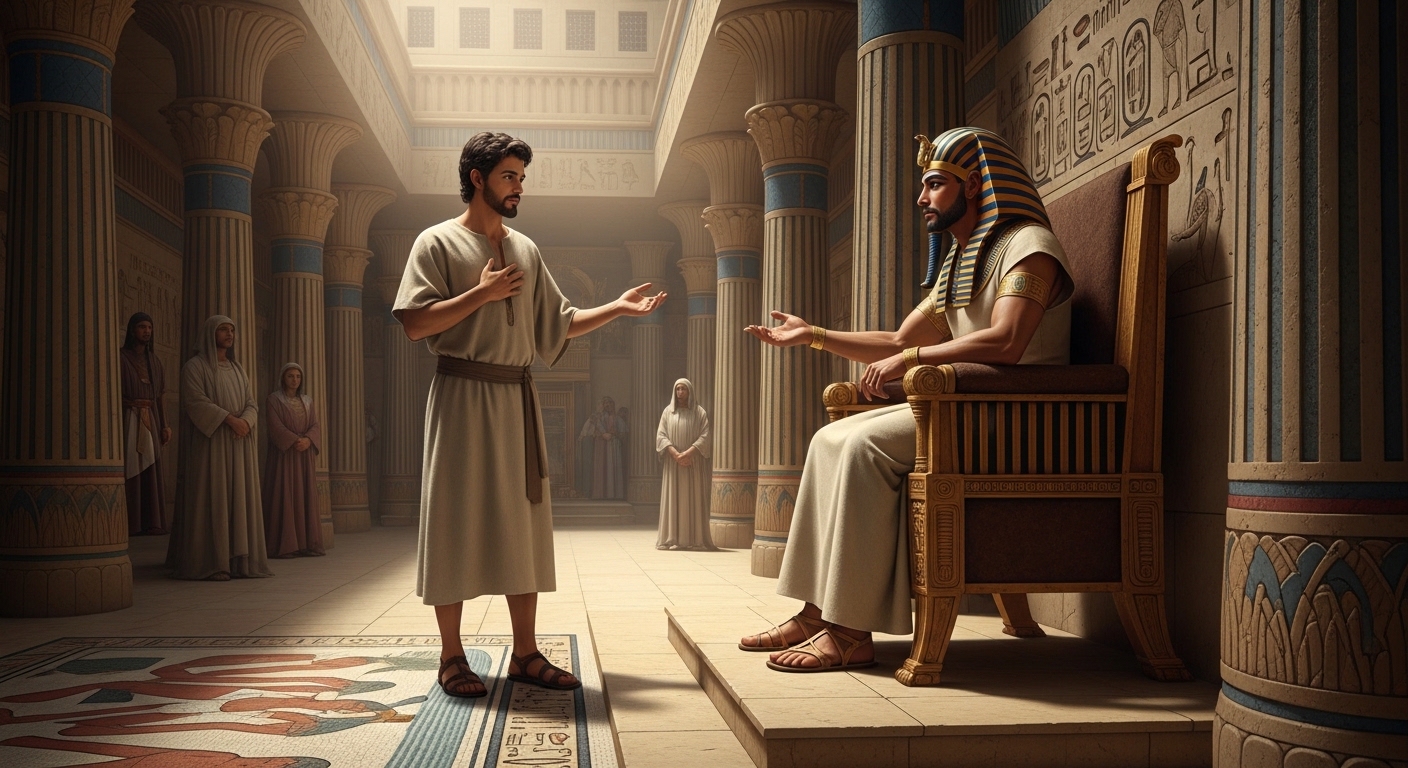
Genesis 41:8 KJVS
And it came to pass in the morning that his spirit was troubled; and he sent and called for all the magicians of Egypt, and all the wise men thereof: and Pharaoh told them his dream; but there was none that could interpret them unto Pharaoh.
From Chains to Chambers of Power
For Joseph, those two years in prison weren’t just a pause in the story—they were a furnace. A quiet, hidden place where God was shaping him in silence. No dreams to interpret, no voices cheering him on, no sign that anything was changing. Just the steady, unseen work of God preparing a man for a moment he couldn’t yet imagine.
And then, suddenly, the door opens.
The same God who allowed Joseph to sit in the shadows now lifts him into the blinding light of Egypt’s throne room. The pedestal wasn’t built overnight; it was carved through waiting, humility, and trust. Now Joseph stands before the most powerful man in the world—not as a frightened prisoner, but as a man who has been inwardly readied for this exact hour.
But the real miracle isn’t that Joseph gets an audience with Pharaoh. It’s what he chooses to do with it.
He doesn’t shrink back. He doesn’t boast. He doesn’t grasp for credit. Instead, he lets the wisdom of God flow through him, unfiltered and unashamed. In a nation filled with idols and superstition, Joseph speaks the name of the living God with clarity and courage. He honors God in a place where God’s name had never been honored before.
This is more than a rise to power—it’s a revelation. A moment where a once-forgotten prisoner becomes a vessel of divine wisdom, standing tall in a pagan empire, carrying the presence of the One who never forgot him.
1. A Memory Awakened, A Destiny Unlocked
Genesis 41:9-13 KJVS
Then spake the chief butler unto Pharaoh, saying, I do remember my faults this day: [10] Pharaoh was wroth with his servants, and put me in ward in the captain of the guard’s house, both me and the chief baker: [11] And we dreamed a dream in one night, I and he; we dreamed each man according to the interpretation of his dream. [12] And there was there with us a young man, an Hebrew, servant to the captain of the guard; and we told him, and he interpreted to us our dreams; to each man according to his dream he did interpret. [13] And it came to pass, as he interpreted to us, so it was; me he restored unto mine office, and him he hanged.
It really is astonishing to watch how God threads His purposes through the smallest, most easily forgotten moments. Think about Joseph’s story: two whole years passed after the butler was released. Two years of silence. Two years where Joseph remained in a prison cell, waiting, hoping, wondering if his kindness had been forgotten.
And in a way, it had been forgotten—at least by the butler. Something so extraordinary, so life‑altering, simply slipped from his mind as he returned to his normal life. But God hadn’t forgotten. God held that memory in reserve, almost like a seed buried in the ground, waiting for the exact moment to break open.
Then, at the perfect time—not a day too early, not a day too late—God brought that memory back to the butler’s mind. A sudden recollection. A spark. And that forgotten moment became the doorway to Joseph’s rise, the beginning of a miracle that would save not only Joseph, but his family, and eventually an entire nation during the famine to come.
It’s wild to realize that what looked like delay was actually precision. What felt like being overlooked was actually God setting the stage. Joseph’s story reminds us that even the memories people forget, the moments that seem wasted, the years that feel silent—God is still working through all of it, weaving something far bigger than we can see.
2. Called at the Perfect Time
Genesis 41:14 KJVS
Then Pharaoh sent and called Joseph, and they brought him hastily out of the dungeon: and he shaved himself, and changed his raiment, and came in unto Pharaoh.
What happens here is breathtaking. After years of silence, years of waiting, years of being overlooked, God moves—and when He moves, He moves fast. Scripture says Joseph was brought out of the prison in haste. The messengers didn’t stroll in; they ran. The Hebrew word rûts literally means “to run,” to move with urgency, as if the whole moment were charged with divine electricity.
It’s almost like watching a sci‑fi scene unfold. One moment Joseph is sitting in the dim stillness of a prison cell, the same place he’s been for so long that the walls probably felt like part of his skin. And then suddenly—almost violently—his world shifts. It’s as if he’s pulled through a portal, transported from obscurity into destiny, from the forgotten past straight into the future God had been preparing all along.
There’s no slow fade. No gentle transition. No easing into the next chapter. It’s immediate. It’s abrupt. It’s the kind of moment where everything changes in a single breath.
And that’s the beauty of God’s timing. When the waiting season ends, it ends quickly. When God decides it’s time to lift you, there are no stopovers, no delays, no bureaucratic pauses.
The same God who allowed the waiting is the God who accelerates the breakthrough. One moment you’re in the place you thought you’d die in; the next, you’re standing in rooms you never imagined, speaking to people you never expected, stepping into a purpose that suddenly feels like it was always chasing you.
Joseph’s story reminds us that God doesn’t just deliver—He sweeps us into the next chapter with a speed that makes the years of waiting make sense.
3. Humility Meets Majesty
Genesis 41:15-16 KJVS
And Pharaoh said unto Joseph, I have dreamed a dream, and there is none that can interpret it: and I have heard say of thee, that thou canst understand a dream to interpret it. [16] And Joseph answered Pharaoh, saying, It is not in me: God shall give Pharaoh an answer of peace.
Standing before the most powerful man in Egypt was no small thing. For Joseph, this moment could have been terrifying—the kind of scene that makes your heart pound and your hands tremble. Pharaoh wasn’t just a ruler; he was treated like a god among men. One wrong word could cost a life.
But Joseph didn’t walk into that throne room alone. He carried the presence of the true God with him. And instead of trying to impress Pharaoh with his own wisdom or negotiate for his own freedom, Joseph did something astonishingly humble: he stepped aside and let God take center stage. He made Pharaoh face the One who had given the dream in the first place—the One who had given Pharaoh his authority, his kingdom, his breath.
Joseph didn’t bargain. He didn’t say, “I’ll interpret your dream if you release me.” He didn’t use the moment to settle scores or demand justice for the years he’d been wronged. He didn’t even hint at the names of those who betrayed him.
He simply stayed faithful to the purpose of the moment: to deliver God’s message: “It is not in me: God shall give Pharaoh an answer of peace.“.
In a room filled with power, Joseph chose humility. In a moment ripe for self‑promotion, he chose obedience. And in doing so, he showed that true strength isn’t found in demanding your rights—it’s found in trusting God enough to let Him speak through you.
4. The Moment Everything Clicked
Genesis 41:25-32 KJVS
And Joseph said unto Pharaoh, The dream of Pharaoh is one: God hath shewed Pharaoh what he is about to do. [26] The seven good kine are seven years; and the seven good ears are seven years: the dream is one. [27] And the seven thin and ill favoured kine that came up after them are seven years; and the seven empty ears blasted with the east wind shall be seven years of famine. [28] This is the thing which I have spoken unto Pharaoh: What God is about to do he sheweth unto Pharaoh. [29] Behold, there come seven years of great plenty throughout all the land of Egypt: [30] And there shall arise after them seven years of famine; and all the plenty shall be forgotten in the land of Egypt; and the famine shall consume the land; [31] And the plenty shall not be known in the land by reason of that famine following; for it shall be very grievous. [32] And for that the dream was doubled unto Pharaoh twice; it is because the thing is established by God, and God will shortly bring it to pass.
You can almost feel the air shift in Pharaoh’s court as Joseph begins to speak. The room that once buzzed with power and protocol suddenly grows still. Every official, every servant, every guard leans in as Joseph delivers a message not from himself, but from God. His words land with a kind of sacred gravity—each one measured, each one absorbed with careful attention.
Joseph explains that Egypt will experience seven years of overflowing abundance, years when the land will give more than anyone could imagine. But then, just as quickly, those years will be swallowed by seven years of severe famine. The Nile—the river Egypt depended on like a heartbeat—would fail to rise and flood the land for seven long years.
It’s the kind of revelation that freezes a room. A truth too heavy to ignore, too urgent to dismiss. And in that silence, Joseph stands there—steady, humble, faithful—speaking the message exactly as God gave it.
Genesis 41:33-37 KJVS
Now therefore let Pharaoh look out a man discreet and wise, and set him over the land of Egypt. [34] Let Pharaoh do this, and let him appoint officers over the land, and take up the fifth part of the land of Egypt in the seven plenteous years. [35] And let them gather all the food of those good years that come, and lay up corn under the hand of Pharaoh, and let them keep food in the cities. [36] And that food shall be for store to the land against the seven years of famine, which shall be in the land of Egypt; that the land perish not through the famine. [37] And the thing was good in the eyes of Pharaoh, and in the eyes of all his servants.
You can almost picture Pharaoh and his officials sitting in stunned silence, their minds racing. Seven years of famine wasn’t just a food shortage—it was a national crisis waiting to happen. It threatened Egypt’s stability, its economy, even Pharaoh’s grip on power. A famine that long could spark unrest, rebellion, and fear among the people.
While the weight of that reality settled heavily on the room, Joseph didn’t leave them drowning in worry. He didn’t stop at the problem—he moved straight into the solution. With a steady voice and a clear mind, he laid out a plan: Pharaoh should appoint a discerning and wise leader to oversee the land. Officers should be placed in every region. And during the seven years of abundance, they should collect twenty percent of the grain—store it, guard it, prepare it—so that when the famine arrives, Egypt will not only survive but stand strong.
Joseph didn’t panic. He didn’t dramatize. He simply offered a path forward, showing that the same God who reveals the problem also provides the wisdom to overcome it.
Genesis 41:38-40 KJVS
And Pharaoh said unto his servants, Can we find such a one as this is, a man in whom the Spirit of God is? [39] And Pharaoh said unto Joseph, Forasmuch as God hath shewed thee all this, there is none so discreet and wise as thou art: [40] Thou shalt be over my house, and according unto thy word shall all my people be ruled: only in the throne will I be greater than thou.
When Joseph laid out the solution before Pharaoh—appoint a discerning and wise man to oversee the land—he never once hinted at himself. He didn’t angle for the position. He didn’t slip in a suggestion. In his heart, Joseph wasn’t dreaming of power; he was dreaming of home.
He longed for freedom, for the chance to see his father again, to return to the life that was taken from him.
But God had a different plan—one Joseph could never have imagined. Joseph wanted to go back to his father, but God intended to bring his father to him. The story wasn’t about returning to the past; it was about stepping into a future God had been shaping all along.
As Pharaoh listened to Joseph—his clarity, his humility, his wisdom—something became unmistakably clear. Pharaoh saw what Potiphar had seen years earlier: this man wasn’t operating on human strength alone. God was with him. And in that moment, God flipped the switch in Joseph’s life. In a single decision, Joseph went from prisoner to the second most powerful man in Egypt.
This moment teaches us something profound. When we follow God’s instructions—when we stay faithful to the purpose He places in front of us—we don’t have to worry about the outcome. We don’t have to stress about where we’ll end up or who we’ll become. God reveals those things in His time, at the exact moment when everything aligns, when every piece finally clicks into place.
Joseph didn’t chase position. He chased obedience. And God took care of the rest.
5. The Humble Vizier
Genesis 41:41-45 KJVS
And Pharaoh said unto Joseph, See, I have set thee over all the land of Egypt. [42] And Pharaoh took off his ring from his hand, and put it upon Joseph’s hand, and arrayed him in vestures of fine linen, and put a gold chain about his neck; [43] And he made him to ride in the second chariot which he had; and they cried before him, Bow the knee: and he made him ruler over all the land of Egypt. [44] And Pharaoh said unto Joseph, I am Pharaoh, and without thee shall no man lift up his hand or foot in all the land of Egypt. [45] And Pharaoh called Joseph’s name Zaphnath–paaneah; and he gave him to wife Asenath the daughter of Poti–pherah priest of On. And Joseph went out over all the land of Egypt.
Joseph was lifted in a single moment from prisoner to vizier—the second most powerful man in Egypt. One day he was forgotten in a cell, and the next he was entrusted with the entire kingdom. Pharaoh placed his own signet ring on Joseph’s hand, giving him authority over every transaction in the land. He was charged with storing grain, preparing the nation for the famine that was coming. He was given a new name—the revealer of mysteries—and a wife, a household, a future.
And then came the command: everyone was to bow before him. Everyone. Even Potiphar and his wife.
Imagine her face in that moment—the woman who once accused him, who watched him dragged away in chains. Now the man she tried to destroy stood above her, robed in authority, surrounded by guards, carrying the power to undo her with a single word. The one they threw into a pit now had the power to cast them into one of their own.
But Joseph didn’t reach for revenge. He didn’t even glance in its direction. He had lived in the darkness once; he refused to return there. He would not let bitterness shrink him back into the man he had been in the pit.
Joseph understood now what God had been doing all along. The threads that once looked like chaos finally formed a pattern. The light broke through the years of confusion, and the sorrow he carried began to dissolve. His life was no longer about surviving the past—it was about stewarding the future. A famine was coming, and he had work to do.
The Dramatic Masterpiece of God
The moment Joseph stands before Pharaoh is the climax of his 13-year journey from the pit to the palace. This event, found in Genesis 41, is marked by a dramatic shift in Joseph’s appearance and a profound demonstration of his spiritual maturity.
- His Identity: from Servant to Revealer of Dreams
- His Authority: from prisoner to Second in Command
- His Appearance: from hairy in rags to shaved clothe in fine linen and gold
- His Focus: from caring two prisoners to saving the entire nation
God’s providence in Joseph’s life unfolded over thirteen long years before he finally saw the full picture. It wasn’t sudden. It wasn’t glamorous. It was a slow emptying, a stripping away, until Joseph became a blank canvas in God’s hands. Day after day, week after week, month after month, year after year—God was painting something he couldn’t yet see.
When Joseph was sold into slavery, he had no glimpse of the canvas. When he served in Potiphar’s house, he couldn’t make out even the faintest sketch. When he was thrown into prison, he didn’t see the colors beginning to take shape. And in those two silent years of waiting, God was adding the smallest, most delicate details.
Then came the day he stood in Pharaoh’s court. And in a single moment, God pulled back the curtain. The masterpiece was revealed—every shadow, every stroke, every painful season woven into a plan more beautiful than Joseph could have imagined.
We might be somewhere on that canvas ourselves. Maybe God is still sketching the outlines. Maybe He’s layering the colors. Maybe He’s adding the fine details we don’t yet understand. But one thing is certain: the same God who shaped Joseph’s life is shaping ours, and in time, He will reveal a masterpiece just as intentional, just as breathtaking.
Thank you for taking the time to read this. God is faithful! God bless you.

Leave a Reply