Genesis 42:1-4 KJVS
Now when Jacob saw that there was corn in Egypt, Jacob said unto his sons, Why do ye look one upon another? [2] And he said, Behold, I have heard that there is corn in Egypt: get you down thither, and buy for us from thence; that we may live, and not die. [3] And Joseph’s ten brethren went down to buy corn in Egypt. [4] But Benjamin, Joseph’s brother, Jacob sent not with his brethren; for he said, Lest peradventure mischief befall him.
It’s the second year of a relentless seven‑year famine, and the weight of it is being felt across the region. At this point in the story, Joseph has risen to extraordinary power in Egypt, yet the narrative is circling back to the place where his suffering began. This is the moment when God’s long‑unfolding plan brings Joseph to the final and most personal chapter: confronting the family that once betrayed him.
Joseph isn’t just managing a national crisis; he’s about to face the very brothers who sold him into slavery and set in motion thirteen years of hardship, injustice, and waiting. Now, as the Vizier of Egypt, he stands in a position of authority they could never have imagined. But the real test isn’t political or administrative—it’s deeply human. How will he respond when the people who wounded him most come seeking help, unaware that the brother they discarded is the one holding their future in his hands?
This moment becomes a crossroads of justice, mercy, memory, and transformation, both for Joseph and for his brothers.
Bow the Knee
Genesis 42:6-8 KJVS
And Joseph was the governor over the land, and he it was that sold to all the people of the land: and Joseph’s brethren came, and bowed down themselves before him with their faces to the earth. [7] And Joseph saw his brethren, and he knew them, but made himself strange unto them, and spake roughly unto them; and he said unto them, Whence come ye? And they said, From the land of Canaan to buy food. [8] And Joseph knew his brethren, but they knew not him.
Joseph’s first dream showed that God had a special purpose for him, and his brothers sensed it. Instead of celebrating what God was doing in Joseph’s life, they let jealousy and anger take over. They weren’t really afraid of the dream itself—they were afraid of what Joseph might grow into, and the possibility that he could one day lead their family.
1. Fulfilled in Silence
Genesis 37:6-8 KJVS
And he said unto them, Hear, I pray you, this dream which I have dreamed: [7] For, behold, we were binding sheaves in the field, and, lo, my sheaf arose, and also stood upright; and, behold, your sheaves stood round about, and made obeisance to my sheaf. [8] And his brethren said to him, Shalt thou indeed reign over us? or shalt thou indeed have dominion over us? And they hated him yet the more for his dreams, and for his words.
Joseph’s first dream wasn’t just a moment of youthful imagination; it was a glimpse into a future his brothers never paused long enough to understand. In the dream, their sheaves bowed to his, and instead of asking what God might be revealing, they reacted out of fear and insecurity.
They assumed Joseph was claiming authority over them, as if he were grasping for power. But the dream was never about domination—it was about preservation.
Their family would one day face a famine so severe that only someone positioned exactly as Joseph would be able to save them. The dream pointed to responsibility, not superiority; to service, not status. If his brothers had taken time to reflect, they might have seen that God was preparing Joseph to become the instrument of their survival.
And in the end, the irony is striking: Joseph’s dream didn’t make him the permanent head of the family. Scripture shows that Judah ultimately became the tribe of leadership—the line of kings, the line of the Messiah. Joseph’s role was different but equally vital. He was not the ruler of the family; he was the rescuer of the family.
Genesis 42:9 KJVS
And Joseph remembered the dreams which he dreamed of them, and said unto them, Ye are spies; to see the nakedness of the land ye are come.
God brought Joseph’s dream to fulfillment in a way that unfolded quietly, almost invisibly, to everyone except Joseph himself. He recognized the moment immediately, but his brothers had no idea that the powerful man standing before them—the one they bowed to—was the same brother they had despised and sold into slavery twenty‑two years earlier.
The scene is thick with emotion. As the brothers kneel, Joseph’s heart must have been pounding—caught between old wounds and the sudden realization that the dream of his youth was happening right in front of him. For the ten brothers, there is no hint of recognition. In their minds, Joseph is either long gone, dead, or living out a forgotten life somewhere in Egypt. All they see is an Egyptian ruler, dressed in authority, speaking through an interpreter, holding their future in his hands.
Joseph sees everything. They see nothing. And in that gap—between what is known and what is hidden—God’s quiet fulfillment takes shape.
2. What Comes Around
Genesis 42:21-23 KJVS
And they said one to another, We are verily guilty concerning our brother, in that we saw the anguish of his soul, when he besought us, and we would not hear; therefore is this distress come upon us. [22] And Reuben answered them, saying, Spake I not unto you, saying, Do not sin against the child; and ye would not hear? therefore, behold, also his blood is required. [23] And they knew not that Joseph understood them; for he spake unto them by an interpreter.
People often begin to see the weight of their past actions only when life places them in a similar kind of hardship. That is exactly what is happening here. As Joseph watches his brothers struggle, he is looking deeper than their words—he is watching their hearts. They are now facing the same kind of fear and helplessness he felt years ago when they tore off his coat, threw him into a pit, and ignored his cries for mercy. He begged them to listen, but they turned away. They heard his tears, but they chose to laugh.
Now the situation is reversed. The brothers are the ones in distress, and the memory of what they did to Joseph rises to the surface. They can feel the echo of that day—the panic, the helplessness, the sense of being trapped at the bottom of a pit.
In this moment, they recognize that God is bringing their past back before them, not to destroy them, but to make them face the truth of their actions and the pain they caused.
Genesis 42:24-25 KJVS
And he turned himself about from them, and wept; and returned to them again, and communed with them, and took from them Simeon, and bound him before their eyes. [25] Then Joseph commanded to fill their sacks with corn, and to restore every man’s money into his sack, and to give them provision for the way: and thus did he unto them.
Joseph watched his brothers fall into fear and confusion, and in that moment he chose Simeon to stay behind as collateral—proof that they would return with Benjamin. The choice wasn’t random. It raises a natural question: why Simeon and not Reuben or Levi?
Ancient Jewish tradition offers a meaningful clue. Simeon is often remembered as the brother who first pushed for Joseph’s death back in Dothan. He was known for a harsh, impulsive spirit, someone quick to draw a weapon and slow to show mercy. By taking Simeon, Joseph may have been doing more than securing their return; he may have been testing the very heart of the brother who once showed him no compassion.
This moment becomes a quiet examination of character. Joseph had changed—he had grown from a wounded teenager into a wise leader. Now he was watching to see whether Simeon had changed too. Would the man who once acted like a violent swordsman now show signs of becoming a guardian, a protector, a brother capable of repentance and responsibility?
Joseph wasn’t just managing logistics; he was reading their hearts, searching for transformation, and giving space for it to emerge.
3. The Leader of the Band
Genesis 42:36-38 KJVS
And Jacob their father said unto them, Me have ye bereaved of my children: Joseph is not, and Simeon is not, and ye will take Benjamin away: all these things are against me. [37] And Reuben spake unto his father, saying, Slay my two sons, if I bring him not to thee: deliver him into my hand, and I will bring him to thee again. [38] And he said, My son shall not go down with you; for his brother is dead, and he is left alone: if mischief befall him by the way in the which ye go, then shall ye bring down my gray hairs with sorrow to the grave.
Judah’s moment only makes full sense when held against what happened earlier in the famine, when Reuben tried—and failed—to persuade Jacob to let Benjamin go. Reuben stepped forward first, offering a bargain that sounded dramatic but rang hollow: “Slay my two sons if I do not bring him back to you.” Jacob refused immediately, and his refusal carried more than fatherly fear. It revealed a deeper truth: he did not trust Reuben with the life of the son he loved most.
Jacob’s reaction wasn’t simply emotional. It was shaped by years of disappointment and by the fragile structure of the family’s future.
- Benjamin represented the future of the blessing. Joseph was believed dead. Benjamin was the last son of Rachel, the last link to the line Jacob had always favored. In Jacob’s mind, Benjamin was not simply a child to protect; he was the heir who would carry forward what Joseph was meant to inherit.
- Reuben’s pledge was empty. Offering his own sons as collateral did nothing to secure Benjamin’s safety. Their deaths would not restore Jacob’s loss; it would only deepen the family’s grief.
- Reuben had already forfeited Jacob’s confidence. His earlier failures—most notably his transgression with Bilhah—had cost him the position of firstborn in Jacob’s eyes. Jacob could not entrust Benjamin to a son whose judgment he no longer respected.
Reuben’s sons, in Jacob’s view, could not replace Benjamin. They were not the future of the covenantal line. Reuben himself was no longer the natural leader of the family, and his children would not rise to that role either. Benjamin, by contrast, stood in Joseph’s shadow—second in Rachel’s line, next in line for the blessing, the one Jacob believed destiny now rested upon.
So when Reuben made his offer, Jacob heard it for what it was: a desperate gesture from a son who no longer held the authority to safeguard the family’s future.
This sets the stage for why Judah’s later intervention carries such weight. Where Reuben’s promise was dramatic but ineffective, Judah’s was costly, personal, and rooted in responsibility. And unlike Reuben, Judah had the moral courage to grow into the role he once abandoned.
Genesis 43:1-5 KJVS
And the famine was sore in the land. [2] And it came to pass, when they had eaten up the corn which they had brought out of Egypt, their father said unto them, Go again, buy us a little food. [3] And Judah spake unto him, saying, The man did solemnly protest unto us, saying, Ye shall not see my face, except your brother be with you. [4] If thou wilt send our brother with us, we will go down and buy thee food: [5] But if thou wilt not send him, we will not go down: for the man said unto us, Ye shall not see my face, except your brother be with you.
Judah is first introduced as the brother who proposes selling Joseph to the passing Ishmaelites—a moment where he treats Joseph less like blood and more like a piece of property that could turn a profit. He rallies his brothers around the idea, reducing a life to a transaction.
Judah now finds himself standing before his aging father, urging him to let Benjamin travel with them—because the Egyptian ruler has made it clear they cannot return for grain without him. For Jacob, the request lands like a weight on his chest. Benjamin is the last living link to Rachel, the only son he believes he has left from her. The memory of Joseph’s disappearance still aches in him, and as far as Jacob knows, that wound came from sending a beloved son away. Letting Benjamin go feels like risking that pain all over again.
Jacob’s fear is not abstract; it is the fear of a father who has already buried a dream once and cannot bear to lose another. And Judah, sensing that fear, steps forward not as the brother who once betrayed Joseph, but as a man willing to stake his own life on Benjamin’s safety.
Genesis 43:8-10 KJVS
And Judah said unto Israel his father, Send the lad with me, and we will arise and go; that we may live, and not die, both we, and thou, and also our little ones. [9] I will be surety for him; of my hand shalt thou require him: if I bring him not unto thee, and set him before thee, then let me bear the blame for ever: [10] For except we had lingered, surely now we had returned this second time.
Judah stepped into the role of Benjamin’s protector with a weight that went far deeper than the moment itself. In offering himself now, he was finally doing what he had failed to do for Joseph all those years ago. The scene before him didn’t just demand courage — it stirred old memories he had tried to bury.
As he spoke, Judah may have felt himself pulled backward into the moment when Joseph cried out from the pit and no one listened. The guilt he carried, long silent, pressed against him now. And echoing through his mind was Reuben’s rebuke from their first trip to Egypt, a sentence that had haunted them all: “Spake I not unto you, saying, Do not sin against the child; and ye would not hear? therefore, behold, also his blood is required.”
Those words had been a reminder of their shared guilt — but for Judah, they cut even deeper. Reuben had tried to stop them. Judah had not. And now, standing before the Egyptian ruler, he felt the full circle of it: another younger brother in danger, another chance to choose differently.
Judah’s plea wasn’t just strategy; it was repentance in motion.
- He was confronting the boy he once abandoned by protecting the boy he refused to lose.
- He was stepping into responsibility he had once shrugged off.
- He was trying, in the only way he could, to rewrite the story he helped break.
In taking Benjamin’s place, Judah wasn’t only saving a brother — he was trying to save the part of himself that had been lost the day they sold Joseph.
4. A Hint of Humility
Genesis 43:15-17 KJVS
And the men took that present, and they took double money in their hand, and Benjamin; and rose up, and went down to Egypt, and stood before Joseph. [16] And when Joseph saw Benjamin with them, he said to the ruler of his house, Bring these men home, and slay, and make ready; for these men shall dine with me at noon. [17] And the man did as Joseph bade; and the man brought the men into Joseph’s house.
Judah’s success in persuading Jacob to release Benjamin set everything into motion. Once Jacob finally relented, the brothers wasted no time. They gathered the gifts their father prepared, took the silver they had mysteriously found in their sacks, and began the long road back to Egypt with a mixture of dread and determination.
When the brothers arrived in Egypt and Joseph caught sight of Benjamin, something shifted immediately. He didn’t greet them in the marketplace or send them to wait in a public hall. Instead, he quietly instructed his steward to bring them to his own house. This was not hospitality—it was intention.
To the brothers, being taken to Joseph’s home must have felt ominous, even dangerous. To Joseph, it was the moment he had been waiting for—the chance to look directly at the family that once betrayed him and discover whether they were still the same men, or whether time, famine, and guilt had changed them.
Genesis 43:19-23 KJVS
And they came near to the steward of Joseph’s house, and they communed with him at the door of the house, [20] And said, O sir, we came indeed down at the first time to buy food: [21] And it came to pass, when we came to the inn, that we opened our sacks, and, behold, every man’s money was in the mouth of his sack, our money in full weight: and we have brought it again in our hand. [22] And other money have we brought down in our hands to buy food: we cannot tell who put our money in our sacks. [23] And he said, Peace be to you, fear not: your God, and the God of your father, hath given you treasure in your sacks: I had your money. And he brought Simeon out unto them.
The first thing the brothers did was lay everything out plainly. They described, without evasion, what had happened the last time they bought grain: the surprise of finding money in their sacks, their confusion, and how they’d come back to return it, insisting a mistake had been made. They spoke with the bluntness of people who had nothing left to hide.
The steward listened, then surprised them. He told them their money was safe with him — and added, almost gently, that God had blessed them. The words landed like a benediction: not a legal judgment, but a small, unexpected mercy that shifted the mood from fear to something like relief.
Genesis 43:29-34 KJVS
And he lifted up his eyes, and saw his brother Benjamin, his mother’s son, and said, Is this your younger brother, of whom ye spake unto me? And he said, God be gracious unto thee, my son. [30] And Joseph made haste; for his bowels did yearn upon his brother: and he sought where to weep; and he entered into his chamber, and wept there. [31] And he washed his face, and went out, and refrained himself, and said, Set on bread. [32] And they set on for him by himself, and for them by themselves, and for the Egyptians, which did eat with him, by themselves: because the Egyptians might not eat bread with the Hebrews; for that is an abomination unto the Egyptians. [33] And they sat before him, the firstborn according to his birthright, and the youngest according to his youth: and the men marvelled one at another. [34] And he took and sent messes unto them from before him: but Benjamin’s mess was five times so much as any of theirs. And they drank, and were merry with him.
When Joseph first saw Benjamin, he couldn’t hide how shaken he was. Twenty-two years had passed since Joseph was taken; Benjamin had been a baby then and likely had no memory of him. That flash of recognition — or simply the sight of Rachel’s last son — stirred something Joseph couldn’t control, a private rush of feeling he kept folded beneath his calm.
Joseph invited his brothers into a formal meal and had his servants seat them in perfect birth order, from eldest to youngest. The brothers were stunned that the attendants somehow knew their exact ranks. In the ancient world, where seating signaled status and inheritance, Joseph was honoring the family’s hierarchy with deliberate precision.
- He arranged the scene to reflect their family structure.
- He watched how they reacted to the honor shown to the younger brother.
- He planned a final test to see whether old jealousies still lived in their hearts.
When the food was served, Joseph gave Benjamin a portion far larger than anyone else’s — five times as much. He wanted to see whether the older brothers, who once sold him out of envy, would now bristle at Benjamin’s favored place or rejoice with him. Their laughter, their shared drinking, and their genuine happiness for Benjamin’s portion told Joseph that something in them had changed: jealousy had loosened its grip, and compassion was beginning to take its place.
5. Silver Cup Gambit
Genesis 44:1-3 KJVS
And he commanded the steward of his house, saying, Fill the men’s sacks with food, as much as they can carry, and put every man’s money in his sack’s mouth. [2] And put my cup, the silver cup, in the sack’s mouth of the youngest, and his corn money. And he did according to the word that Joseph had spoken. [3] As soon as the morning was light, the men were sent away, they and their asses.
Joseph had been waiting for this moment, and now he quietly put his plan into action. After the meal he asked his steward to repeat what had happened before: fill the brothers’ sacks with grain and secretly place money inside. But this time there was one crucial difference — in Benjamin’s sack Joseph slipped his own silver cup. Then, before dawn, he sent them on their way.
Joseph didn’t choose that cup at random. In that world, silver was a precious, hard-to-get metal, and a personal cup of silver would have been one of his most valuable possessions. By planting it with Benjamin, Joseph was risking something costly to create a test that would reveal the true shape of his brothers’ hearts.
Why the test mattered?
- It was a probe of character — Joseph wanted to know whether the men who once betrayed him would now protect the youngest brother or abandon him to save themselves.
- It was deliberate — Joseph recreated the earlier scene so he could watch how they behaved under the same pressure.
- It was personal — using his own cup made the test intimate and high-stakes.
Genesis 44:4-9 KJVS
And when they were gone out of the city, and not yet far off, Joseph said unto his steward, Up, follow after the men; and when thou dost overtake them, say unto them, Wherefore have ye rewarded evil for good? [5] Is not this it in which my lord drinketh, and whereby indeed he divineth? ye have done evil in so doing. [6] And he overtook them, and he spake unto them these same words. [7] And they said unto him, Wherefore saith my lord these words? God forbid that thy servants should do according to this thing: [8] Behold, the money, which we found in our sacks’ mouths, we brought again unto thee out of the land of Canaan: how then should we steal out of thy lord’s house silver or gold? [9] With whomsoever of thy servants it be found, both let him die, and we also will be my lord’s bondmen.
Joseph sent his steward after them and, when the men were stopped, accused them of stealing his silver cup. The charge landed like a thunderclap. The brothers protested with raw, immediate honesty — they knew they hadn’t taken it — and their fear showed in the only way they could think to answer: they offered themselves as bondsmen, even saying that whoever was found with the cup should die.
Their reaction was a mix of panic and principle. They weren’t scheming or evasive; they were willing to accept the worst rather than run from the accusation. That readiness to be bound or to sacrifice one of their own revealed both how desperate they were and how seriously they took the steward’s charge.
Genesis 44:12-16 KJVS
And he searched, and began at the eldest, and left at the youngest: and the cup was found in Benjamin’s sack. [13] Then they rent their clothes, and laded every man his ass, and returned to the city. [14] And Judah and his brethren came to Joseph’s house; for he was yet there: and they fell before him on the ground. [15] And Joseph said unto them, What deed is this that ye have done? wot ye not that such a man as I can certainly divine? [16] And Judah said, What shall we say unto my lord? what shall we speak? or how shall we clear ourselves? God hath found out the iniquity of thy servants: behold, we are my lord’s servants, both we, and he also with whom the cup is found.
The moment the silver cup was found, the brothers did something they had never done in Joseph’s youth: they stood together. Instead of abandoning Benjamin the way they once abandoned Joseph, they immediately accepted shared responsibility. Their words were simple but carried the weight of a changed conscience: “behold, we are my lord’s servants, both we, and he also with whom the cup is found“.
Their reaction shows a profound shift in character.
- They offered themselves as servants, not out of guilt for a crime they didn’t commit, but out of loyalty to their youngest brother.
- They refused to separate themselves from Benjamin, even though doing so would have secured their own freedom.
- They chose solidarity over self‑preservation, a stark contrast to the day they sold Joseph and walked away from his cries.
This is the first clear sign Joseph has been waiting for — proof that the men who once betrayed him are no longer the same. Their instinct is no longer to sacrifice the favored son but to protect him, even at great cost to themselves.
Genesis 44:17-18,30-34 KJVS
And he said, God forbid that I should do so: but the man in whose hand the cup is found, he shall be my servant; and as for you, get you up in peace unto your father. [18] Then Judah came near unto him, and said, Oh my lord, let thy servant, I pray thee, speak a word in my lord’s ears, and let not thine anger burn against thy servant: for thou art even as Pharaoh. [30] Now therefore when I come to thy servant my father, and the lad be not with us; seeing that his life is bound up in the lad’s life; [31] It shall come to pass, when he seeth that the lad is not with us, that he will die: and thy servants shall bring down the gray hairs of thy servant our father with sorrow to the grave. [32] For thy servant became surety for the lad unto my father, saying, If I bring him not unto thee, then I shall bear the blame to my father for ever. [33] Now therefore, I pray thee, let thy servant abide instead of the lad a bondman to my lord; and let the lad go up with his brethren. [34] For how shall I go up to my father, and the lad be not with me? lest peradventure I see the evil that shall come on my father.
Joseph pressed the test to its breaking point. He told his brothers that only Benjamin—the one “caught” with the cup—would stay behind as a servant, and the rest were free to return home. It was the perfect reenactment of their old sin: abandon the favored brother and save themselves.
But this time, something entirely different happened.
Judah, the very brother who once suggested selling Joseph, refused to repeat that story. He stepped forward and pleaded—not with excuses, not with clever arguments, but with the weight of a promise he had made to their father. He told Joseph that he could not return home without Benjamin, that the loss would kill Jacob, and that he himself would rather stay behind as a slave than see that happen.
Judah offered his own life in Benjamin’s place.
For Joseph, this was the clearest sign of all. The brother who once profited from his disappearance was now willing to be the one who disappeared. Judah was ready to be sold, not out of jealousy or greed, but out of love—for Benjamin, and for the father whose heart he had once helped break.
It was the reversal Joseph had been waiting for:
- the betrayer becoming the protector,
- the instigator of his suffering becoming the one willing to suffer,
- the family that once fractured beginning to heal.
Judah’s transformation was the proof Joseph needed that the story could finally turn toward reconciliation.
I Am Joseph
Genesis 45:1-5 KJVS
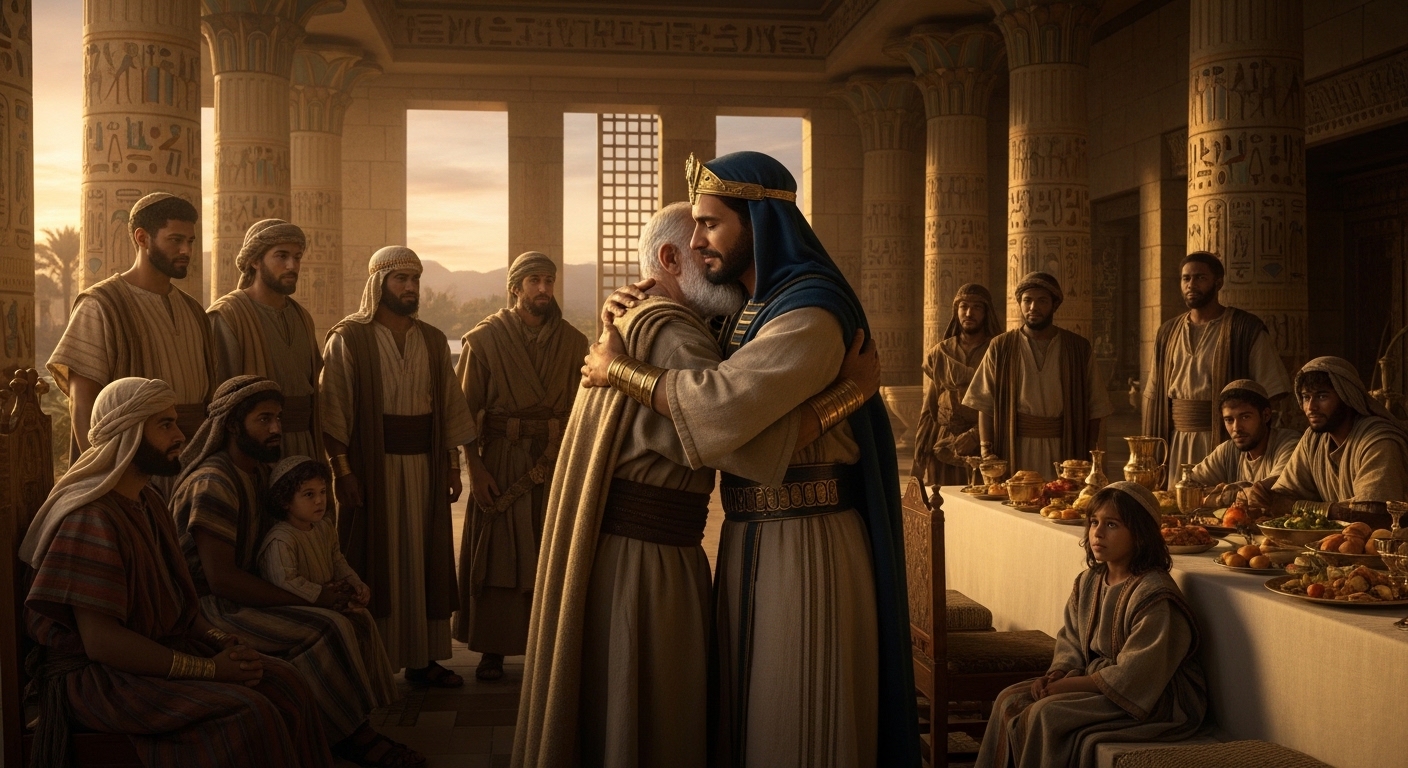
Then Joseph could not refrain himself before all them that stood by him; and he cried, Cause every man to go out from me. And there stood no man with him, while Joseph made himself known unto his brethren. [2] And he wept aloud: and the Egyptians and the house of Pharaoh heard. [3] And Joseph said unto his brethren, I am Joseph; doth my father yet live? And his brethren could not answer him; for they were troubled at his presence. [4] And Joseph said unto his brethren, Come near to me, I pray you. And they came near. And he said, I am Joseph your brother, whom ye sold into Egypt. [5] Now therefore be not grieved, nor angry with yourselves, that ye sold me hither: for God did send me before you to preserve life.
Joseph reached the point where he couldn’t hold himself together any longer. Everything he had watched, every choice his brothers had made, every sign of their changed hearts—it was enough. He finally believed it. The men who once sold him were no longer those same men.
He ordered everyone out of the room except his brothers. The sudden emptiness must have made the air feel heavier, the silence sharper. The brothers stood there, frightened and unsure, trying to guess what judgment was about to fall on them. Then Joseph broke. He revealed who he truly was.
The brothers didn’t understand at first. The words didn’t make sense. How could the powerful Egyptian ruler standing before them be Joseph—the brother they had assumed was living as a slave somewhere, or more likely dead? Their minds must have raced, trying to reconcile the face they saw with the name they heard. And then the realization hit.
The man before them—the second most powerful figure in Egypt—was the same boy they had betrayed, the same brother they had abandoned to a fate they never expected to see reversed.
A chill must have run straight through them.
Their stomachs dropping.
Their hands trembling.
Their thoughts spiraling into fear: Would they survive this? Would Joseph take revenge? Would they ever see home again?
They stood there caught between disbelief and terror, trying to absorb the impossible truth spoken by the brother they once sent away.
Genesis 45:6-8 KJVS
For these two years hath the famine been in the land: and yet there are five years, in the which there shall neither be earing nor harvest. [7] And God sent me before you to preserve you a posterity in the earth, and to save your lives by a great deliverance. [8] So now it was not you that sent me hither, but God: and he hath made me a father to Pharaoh, and lord of all his house, and a ruler throughout all the land of Egypt.
Joseph didn’t meet their terror with anger. Instead, he invited them to come closer, speaking with a gentleness that must have stunned them. The brothers braced for judgment, but what they heard was comfort. Joseph explained that everything they had done to him—every wound, every betrayal—had been woven by God into a larger purpose. He didn’t tell the story with bitterness or accusation. He lifted it up with gratitude, seeing God’s hand where others might have seen only tragedy.
He told them that his journey to Egypt was not simply about his own survival or even theirs. God had sent him ahead to preserve life—not just the life of their family, but the lives of countless people who would have starved in the famine. What they meant for harm, God had transformed into a means of rescue.
Joseph’s humility, his refusal to retaliate, and his insistence on God’s purpose turned a moment of fear into a moment of grace. His brothers expected punishment; instead, they found forgiveness shaped by a vision far bigger than their past.
Joseph’s Dream in Its Full Glory
Genesis 45:7-8 KJVS
And God sent me before you to preserve you a posterity in the earth, and to save your lives by a great deliverance. [8] So now it was not you that sent me hither, but God: and he hath made me a father to Pharaoh, and lord of all his house, and a ruler throughout all the land of Egypt.
Joseph’s dream looks simple on the surface—just a young man imagining a future where his family bows to him, a picture of authority or firstborn honor. But that’s only how it appears from a human angle. From God’s perspective, the dream was far larger, far wider, and far more world‑shaping than anyone in that family could have imagined.
Joseph’s brothers took the dream personally, as if it were about pride or favoritism. But God was revealing something far more magnificent. His plan wasn’t limited to Israel’s household; it stretched across nations, across famine years, across the future of His people. Joseph’s suffering wasn’t wasted pain—it was the shaping of a man who would one day preserve countless lives.
Joseph’s brothers acted out of jealousy and selfishness, but God used even their sin to set His purpose in motion. What looked like betrayal became the doorway to destiny.
- Joseph spent thirteen years in slavery and prison, yet he never stopped trusting God.
- In every place he landed—Potiphar’s house, the prison, Pharaoh’s court—God prospered him.
- Through every rise and fall, Joseph held onto God’s presence more tightly than his circumstances.
Joseph didn’t just endure hardship; he grew through it. His trust in God didn’t fail, and God’s purpose didn’t falter. The dream wasn’t about Joseph being exalted—it was about God positioning him to save a world on the brink of starvation.
Joseph’s dream wasn’t merely a family story. It was a salvation story.
In every place God sets us, the story is almost never just about our own comfort or struggle. When hardship hits, our instinct is to shrink the world down to our pain, our needs, our fears. But God sees a far wider horizon. He is often shaping something larger than we can imagine—something that reaches beyond our immediate circle, touching lives we don’t even know yet.
Trials feel personal, but God’s purposes are expansive.
What looks like a setback may be preparation.
What feels like delay may be positioning.
What seems to affect only us may become provision for many.
God’s work in us is rarely only for us. It becomes a blessing that spills outward—meeting needs, strengthening others, and weaving our story into something far greater than we could have planned.
Thank you for taking the time to read this. God is faithful! God bless you.

Leave a Reply