Exodus 32:9-11 KJ21
And the LORD said unto Moses, “I have seen this people, and behold, it is a stiffnecked people. [10] Now therefore let Me alone, that My wrath may wax hot against them, and that I may consume them; and I will make of thee a great nation.” [11] And Moses besought the LORD his God and said, “LORD, why doth Thy wrath wax hot against Thy people, whom Thou hast brought forth out of the land of Egypt with great power and with a mighty hand?
Moses Compared to Abraham
Abraham and Moses both stood in the gap for others, but the way they did it reveals the different hearts of their callings. Abraham interceded like a friend sitting across the table from God, carrying the weight of his family in his hands. Moses interceded like a leader standing before a nation, pleading for an entire people he had been entrusted to guide. One prayed as a father, the other as a mediator. Both carried love, just shaped by the roles God gave them.
1. The Spark Behind Every Argument
Abraham and Moses both reached for God’s character when they prayed, but each grabbed hold of a different part of His heart.
When Abraham stood before God over Sodom and Gomorrah, he leaned hard on God’s justice, He spoke to God like someone who trusted the Judge of all the earth to be fair: “Will not the Judge of all the earth do right?“ Almost doing the moral “math” out loud—”If there are fifty righteous… forty… even ten… shouldn’t that goodness count for something?” His plea was rooted in the belief that God would never do wrong by the innocent.
Moses, on the other hand, didn’t appeal to Israel’s goodness—he knew they didn’t have much to stand on. Instead, he leaned into God’s mercy and God’s reputation. He reminded God of His own promises, His unfailing love, and how the nations were watching. Moses wasn’t arguing Israel’s worthiness; he was holding up God’s faithfulness.
Two men, two approaches—one appealing to God’s justice, the other to His mercy. Both trusting that God’s heart could be moved.
2. The Outer Edges of Intercession
Abraham’s intercession has this wide, almost universal embrace to it. When he stood before God about Sodom, he wasn’t only thinking of Lot—he was pleading for an entire city. There’s a tenderness in that, a kind of concern that stretches beyond family lines into the fate of humanity itself. His question to God still echoes into our own lives: “wilt thou also destroy and not spare the place for the fifty righteous that are therein?” It nudges us to wonder about our own presence in the places we call home. Does the way we live—quietly, faithfully—have the power to shelter the world around us?
Moses’ intercession, on the other hand, feels deeply communal, almost familial. The man who once tended sheep in Midian became, in time, the shepherd of Israel. His prayers weren’t abstract or universal; they were rooted in the survival and identity of a specific people. When he cries out, “Thy people, whom Thou hast brought forth out of the land of Egypt.” he’s carrying them—every flaw, every fear, every hope—on his shoulders. His intercession is the voice of a leader who refuses to abandon his flock.
3. The Level of Self-Sacrifice
Abraham stood his ground with a kind of quiet courage. He didn’t storm heaven; he entered a conversation. Step by step, he bargained the number down to ten, and then he stopped—not out of fear, but because the trusted. He knew God saw Lot as righteous, and that the real question wasn’t whether God would protect Lot, but whether Lot would remain in a place already collapsing under the weight or its own corruption. When Sodom and Gomorrah finally reached the point of no return, God didn’t abandon Lot to the fallout. He pulled him and his family out before judgement fell.
Moses on the other hand, went on further. He didn’t just negotiate; he offered himself. He stood before God and said, in essence, “Blot me out of your book” if the people won’t be forgiven. It was a staggering act of love—Moses placing his own legacy, his own future, on the altar for the sake of the people who had just betrayed everything they’d been given. Israel had all bowed to the golden calf; there was no righteous remnant to appeal to. So Moses put himself forward, the only one left to stand in the gap.
This Deserves Your Attention
Abraham shows us that it’s possible to wrestle with God’s justice without losing reverence. He questioned boldly, but always from a place of moral clarity. And even when he wasn’t speaking, his quiet obedience became its own kind of intercession—an act that echoed forward into the lives of those who would come after him.
Moses, on the other hand, is the opposite kind of intercessor. He’s loud, raw, unfiltered—the voice of a people who had forgotten how to speak for themselves. Through him we learn something different: that even when we’ve forfeited every moral argument, we can still fall back on God’s mercy. Moses stands there as proof that grace can be appealed to even when righteousness is nowhere to be found.
Moses the Ultimate Defense Attorney
Exodus 24:3,7 KJVS
And Moses came and told the people all the words of the LORD, and all the judgments: and all the people answered with one voice, and said, All the words which the LORD hath said will we do. [7] And he took the book of the covenant, and read in the audience of the people: and they said, All that the LORD hath said will we do, and be obedient.
The Israelites promised—twice—that they would follow everything the Lord commanded. They said it right after hearing the Ten Commandments, fully aware that they were never to bow down to other gods or carve images to worship.
But knowing something and living it out are two different battles. They had left Egypt with their bodies, yet Egypt sill clung to their hearts. The habits, the symbols, the spiritual patterns of their old life still held them. they were free on the outside, but inside they were still tangled in the religion and rhythms of the place they had just escaped.
Exodus 32:1-3 KJVS
And when the people saw that Moses delayed to come down out of the mount, the people gathered themselves together unto Aaron, and said unto him, Up, make us gods, which shall go before us; for as for this Moses, the man that brought us up out of the land of Egypt, we wot not what is become of him. [2] And Aaron said unto them, Break off the golden earrings, which are in the ears of your wives, of your sons, and of your daughters, and bring them unto me. [3] And all the people brake off the golden earrings which were in their ears, and brought them unto Aaron.
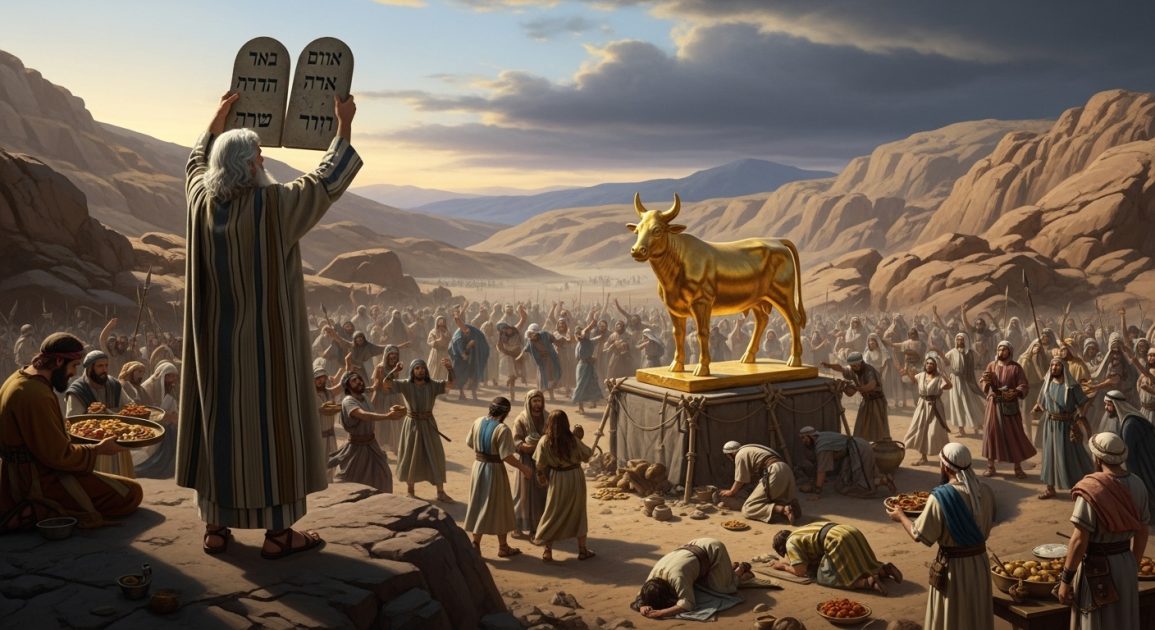
The Golden Calf episode might be the most dramatic “lawyer moment” in the entire Bible. Moses is on Mount Sinai, receiving the Ten Commandments—etched by God’s own hand—while, at the very same time, the people below are busy breaking the first two commandments in spectacular fashion by melting their jewelry into a golden bull.
Exodus 32:4-6 KJVS
And he received them at their hand, and fashioned it with a graving tool, after he had made it a molten calf: and they said, These be thy gods, O Israel, which brought thee up out of the land of Egypt. [5] And when Aaron saw it, he built an altar before it; and Aaron made proclamation, and said, To morrow is a feast to the LORD. [6] And they rose up early on the morrow, and offered burnt offerings, and brought peace offerings; and the people sat down to eat and to drink, and rose up to play.
When God tells Moses what’s happening, the conversation that unfolds is nothing short of a high‑stakes negotiation. It’s tense, emotional, and razor‑sharp—Moses standing between a furious God and a faithless people, arguing, pleading, and reasoning like a man who knows the fate of an entire nation hangs on every word
1. Defense Attorney’s Divine Test
Exodus 32:7-10 KJVS
And the LORD said unto Moses, Go, get thee down; for thy people, which thou broughtest out of the land of Egypt, have corrupted themselves: [8] They have turned aside quickly out of the way which I commanded them: they have made them a molten calf, and have worshipped it, and have sacrificed thereunto, and said, These be thy gods, O Israel, which have brought thee up out of the land of Egypt. [9] And the LORD said unto Moses, I have seen this people, and, behold, it is a stiffnecked people: [10] Now therefore let me alone, that my wrath may wax hot against them, and that I may consume them: and I will make of thee a great nation.
God’s first response to Moses is striking. He creates distance, telling Moses, “Go down—your people, the ones you brought out of Egypt, have corrupted themselves.” It’s a deliberate shift. God doesn’t call them “My people,” nor does He say, “whom I brought out.” The language is cold, almost legal.
In the ancient Near Eastern world, covenant language worked a lot like marriage or adoption. When God first formed His covenant with Israel, He claimed them as His own: “My people… I brought you out of Egypt.” So when He suddenly switches to “your people” and “you brought them up,” it’s as if He’s placing the covenant on the table and sliding it back toward Moses—like handing over divorce papers.
And then comes the offer: God tells Moses He could start over, build a new nation from Moses’ own line. It’s a moment loaded with tension, identity, and the weight of covenant love.
Exodus 32:11 KJVS
And Moses besought the LORD his God, and said, LORD, why doth thy wrath wax hot against thy people, which thou hast brought forth out of the land of Egypt with great power, and with a mighty hand?
Many theologians point out that God’s sudden “disowning” of Israel seems intentional—a way of testing Moses’ heart. If Moses had accepted God’s wording and agreed, the nation might have been wiped out right there. But Moses refuses to let the relationship fracture. He pushes the covenant language right back across the table and says, in effect, “LORD, why doth thy wrath wax hot against thy people, which thou hast brought forth out of the land of Egypt.“
It’s a bold, almost instinctive response. Moses won’t sign the “divorce papers.” Instead, he steps into the breach and reminds God of His own words, His own promises, his own story with Israel.
2. Defense Attorney’s Argument
Moses refuse to take the bait. Instead of accepting God’s distancing language, he steps right into the gap and begins building his case. He doesn’t argue randomly—he makes deliberate, covenant-anchored points meant to pull God back into relationship with His people.
His first move is an “ownership reversal.” God had said, “your people… whom you brought up,” but Moses immediately turns it around: “why doth thy wrath wax hot against thy people, which thou hast brought?” He gently but firmly reminds God that Israel isn’t Moses’ project—they are God’s own, born out of God’s promise and God’s rescue.
It’s a bold, relational, deeply loyal response—Moses standing in the breach, refusing to let the covenant unravel.
Exodus 32:12 KJVS
Wherefore should the Egyptians speak, and say, For mischief did he bring them out, to slay them in the mountains, and to consume them from the face of the earth? Turn from thy fierce wrath, and repent of this evil against thy people.
Next, Moses makes what you could almost call his “PR argument.” He appeals to God’s reputation among the nations. If Israel were wiped out in the wilderness, Moses says, the Egyptians would twist the story—claiming that God rescued the Hebrews only to destroy them later. In other words, Bod’s lory would be misunderstood, His character misread, His intentions questioned.
Moses is essentially saying, “This is isn’t just about Israel. The whole world is watching what kind of God You are.“
Exodus 32:13 KJVS
Remember Abraham, Isaac, and Israel, thy servants, to whom thou swarest by thine own self, and saidst unto them, I will multiply your seed as the stars of heaven, and all this land that I have spoken of will I give unto your seed, and they shall inherit it for ever.
Moses’ final appeal is what you might call his “legacy move.” He reaches back into the deep story—invoking Abraham, Isaac, and Israel—not as a formality, but as a reminder of the bond God Himself initiated. He brings up the oath God made to the patriarchs, and oath described as unbreakable. And the weightiest par is this: when God made that promise to Abraham, He didn’t just speak it into the air, He bound Himself to it. He tied His own name, His own character, to that commitment.
Genesis 15:17-18 KJVS
And it came to pass, that, when the sun went down, and it was dark, behold a smoking furnace, and a burning lamp that passed between those pieces. [18] In the same day the LORD made a covenant with Abram, saying, Unto thy seed have I given this land, from the river of Egypt unto the great river, the river Euphrates:
3. Defense Attorney’s Horror
Exodus 32:14-16 KJVS
And the LORD repented of the evil which he thought to do unto his people. [15] And Moses turned, and went down from the mount, and the two tables of the testimony were in his hand: the tables were written on both their sides; on the one side and on the other were they written. [16] And the tables were the work of God, and the writing was the writing of God, graven upon the tables.
One of the quiet burdens of being a defender, they say, is the moment you realize your client might actually be guilty. Moses had just finished pleading Israel’s case before God—arguing, interceding, standing in the gap—and when God relented from the destruction He had planned, Moses turned and walked back down the mountain. In his hands he carried the very work of God, the tablets etched by divine fingers.
As he and Joshua descended, the air shifted. Joshua paused, listening. From below came a roar—shouting, singing, something wild and chaotic. He thought it sounded like war.
But nothing could have prepared Moses for what he saw when the camp finally came into view. The scene was so grotesque, so far from everything God had just entrusted to him, that you can almost imagine the thought flashing through his mind: No wonder God wanted to burn this whole place down.
Exodus 32:25 KJVS
And when Moses saw that the people were naked; (for Aaron had made them naked unto their shame among their enemies:)
There they were—his people—dancing, shouting, singing around a golden calf… and many of them were naked. It wasn’t just idolatry; it was a complete unraveling of everything they had just promised God on that mountain.
4. Defense Attorney’s Purging
Exodus 32:26-28 KJVS
Then Moses stood in the gate of the camp, and said, Who is on the LORD’S side? let him come unto me. And all the sons of Levi gathered themselves together unto him. [27] And he said unto them, Thus saith the LORD God of Israel, Put every man his sword by his side, and go in and out from gate to gate throughout the camp, and slay every man his brother, and every man his companion, and every man his neighbour. [28] And the children of Levi did according to the word of Moses: and there fell of the people that day about three thousand men.
After Moses had stood before God and begged for mercy, he descended the mountain carrying the tablets—God’s own handiwork—only to discover that Israel’s spiritual rebellion had exploded into a full collapse of order. What had begun as idolatry had spiraled into chaos.
In the ancient world, the city gate was the place where judgments were made and justice was carried out. By positioning himself there, Moses wasn’t just returning to camp—he was taking his seat as Israel’s judge. He had just defended these people before God, arguing for their survival, and now he was about to do the hard work of proving they were still worth defending.
He didn’t form a committee or call for a slow investigation. He demanded a clear, public choice: “Who is on the LORD’s side? Come to me.” It was a call meant to pierce their memory. Not long before, they had stood trembling at Sinai and promised, “All that the LORD has said we will do, and we will obey.” Now Moses was asking them to show whether those words meant anything. He was ready to stand for them again—but only if they were willing to stand with God.
From a narrative perspective, the frenzy in the camp had become like a spiritual infection—something spreading, consuming, pulling the entire nation toward destruction. Moses called the Levites to act decisively, cutting out the source of the rebellion before it poisoned the whole body of Israel. Though the entire camp had participated in the worship of the calf, three thousand were singled out—likely the instigators, the ones who refused to stop even after Moses returned, the ones who kept the fire of rebellion burning.
Exodus 32:29 KJVS
For Moses had said, Consecrate yourselves to day to the LORD, even every man upon his son, and upon his brother; that he may bestow upon you a blessing this day.
Moses then called the people to consecrate themselves—to come clean, to face what they had done, and to turn away from the rebellion that had nearly destroyed them. His call wasn’t just about ritual purity; it was an invitation to return to God with honesty and humility.
In that moment, Moses was teaching them something essential: blessing doesn’t come to those who pretend they’ve done nothing wrong. It comes to those who are willing to turn around, to repent, to realign their lives with God’s ways. Obedience wasn’t meant to be a burden—it was the path back to life, protection, and restored relationship.
5. Defense Attorney’s Sacrifice
Exodus 32:30-32 KJVS
And it came to pass on the morrow, that Moses said unto the people, Ye have sinned a great sin: and now I will go up unto the LORD; peradventure I shall make an atonement for your sin. [31] And Moses returned unto the LORD, and said, Oh, this people have sinned a great sin, and have made them gods of gold. [32] Yet now, if thou wilt forgive their sin―; and if not, blot me, I pray thee, out of thy book which thou hast written.
After the purging of the camp, Moses climbed back up the mountain to face God once more. This time, he wasn’t coming as a defender of a misunderstood people—he was coming on behalf of a nation he knew was guilty. He laid their condition bare before the Lord with painful honesty: “This people have sinned a great sin.”
Moses wasn’t trying to soften the truth or excuse their rebellion. He was acknowledging that God had every right to judge them, every right to wipe them out for what they had done. And yet, even as he affirmed God’s justice, Moses did something astonishing. He offered himself in their place.
He was willing to lose his life, his future, even his name in God’s book if it meant Israel could be spared. These were the same people who had grumbled about him, doubted him, and turned against him the moment he disappeared from sight. But Moses didn’t just pray for them—he offered to suffer for them.
It was the ultimate act of leadership: standing between a holy God and a broken people, willing to bear the cost himself so they might live.
Key Characteristics of Moses’ Intercession
Exodus 33:11 KJVS
And the LORD spake unto Moses face to face, as a man speaketh unto his friend. And he turned again into the camp: but his servant Joshua, the son of Nun, a young man, departed not out of the tabernacle.
What makes Moses’ intercession so extraordinary is the depth of empathy he carried for his people. Even when they complained about him, rejected his leadership, or talked about stoning him, his instinct wasn’t to defend himself—it was to fall on his face before God and plead for their lives. His compassion ran deeper than their failures.
Moses became a living bridge between justice and mercy. His prayers show what it looks like when a human being walks so closely with God that honest, selfless conversation can shape the course of divine history. It’s a relationship marked not by entitlement, but by friendship—where a person cares so deeply for others that they dare to stand in the gap, appealing to God’s heart with humility and courage.
Thank you for taking the time to read this. God is faithful! God bless you.

Leave a Reply