Numbers 14:8-9 KJVS
If the LORD delight in us, then he will bring us into this land, and give it us; a land which floweth with milk and honey. [9] Only rebel not ye against the LORD, neither fear ye the people of the land; for they are bread for us: their defence is departed from them, and the LORD is with us: fear them not.
The story of the twelve spies in Numbers 13 feels like one of those “everything could have gone differently” moments in Israel’s journey. It’s the point where a people standing on the edge of promise end up stepping into years of wandering instead.
Why Send Spies?
At first glance it does seem strange that an all-knowing God would send people to “scout” land He already knows. In the story, though, the mission wasn’t about informing God; it was a rite of passage for the people—a move from being rescued refugees to becoming a nation that must learn to trust, decide, and take responsibility for its future.
Numbers 13:17-20 KJVS
And Moses sent them to spy out the land of Canaan, and said unto them, Get you up this way southward, and go up into the mountain: [18] And see the land, what it is; and the people that dwelleth therein, whether they be strong or weak, few or many; [19] And what the land is that they dwell in, whether it be good or bad; and what cities they be that they dwell in, whether in tents, or in strong holds; [20] And what the land is, whether it be fat or lean, whether there be wood therein, or not. And be ye of good courage, and bring of the fruit of the land. Now the time was the time of the firstripe grapes.
1. A Promise They’d Never Seen
God had been telling them for years that the land was “flowing with milk and honey,” but for a generation raised in Egypt’s mud pits and the emptiness of the Sinai, those words didn’t mean much. Their whole world had been bricks, straw, the Nile, and the shadow of Pharaoh’s palace. Abundance wasn’t something they had ever seen. So when God spoke of a promised land, they had no real picture of what that looked like — no frame of reference for a place overflowing with goodness.

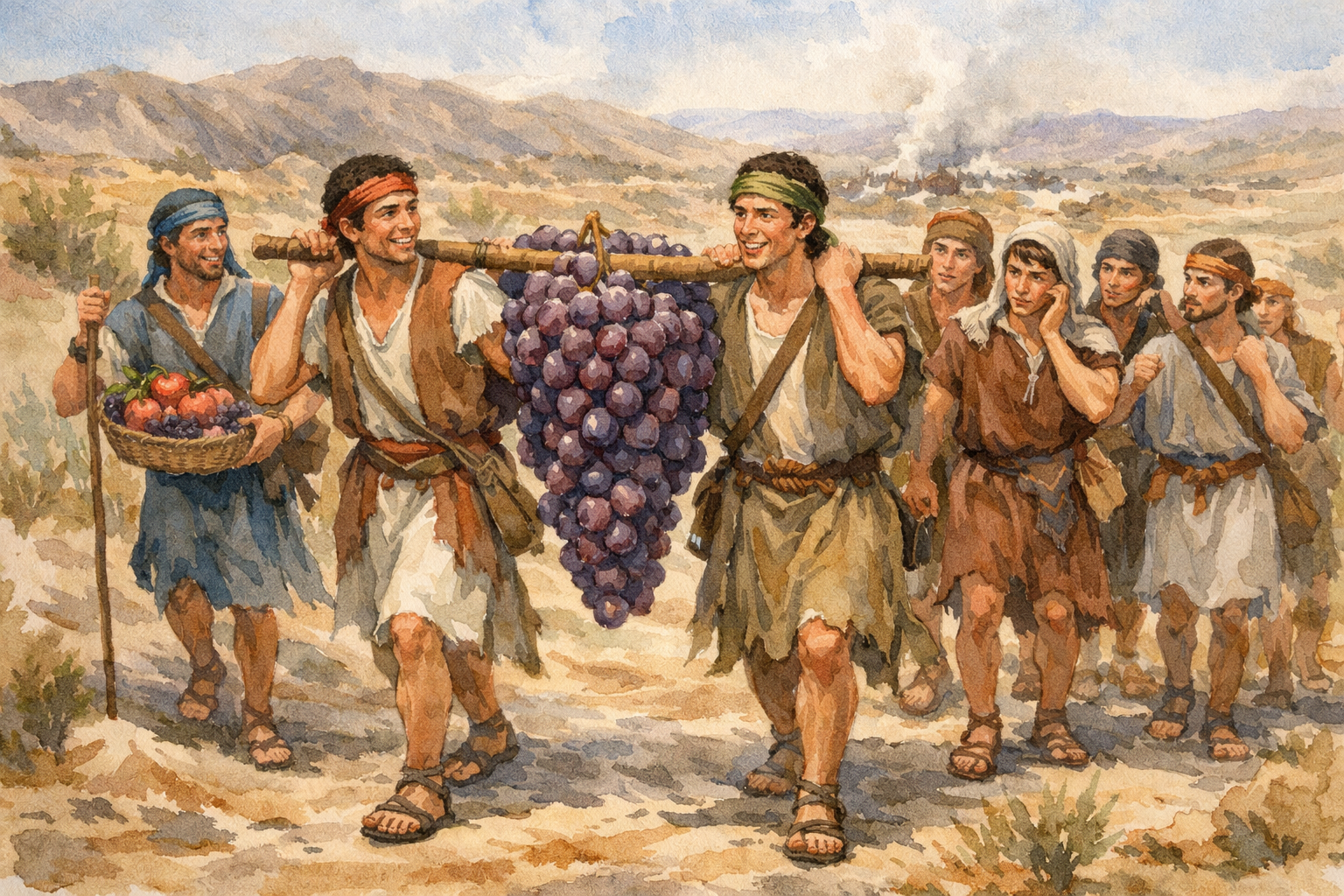
God wanted them to see something real, something they could hold in their hands, so the promise stopped feeling like a distant idea and started feeling like a future worth fighting for. Those pomegranates and figs weren’t just fruit—they were motivation. They gave the soldiers a clear why that made the how of the battles ahead feel purposeful.
2. Seeing Giants or Seeing God

The spy mission was like a final exam before stepping into the promised land. God already knew everything about the land — that wasn’t the point. The real test was for the Israelites. They needed to see the land with their own eyes, to discover who they were becoming, and to decide how they would move forward. Their reaction to what they saw would reveal their identity, their courage, and their trust. (Source image)
Numbers 13:28-33 KJVS
Nevertheless the people be strong that dwell in the land, and the cities are walled, and very great: and moreover we saw the children of Anak there. [29] The Amalekites dwell in the land of the south: and the Hittites, and the Jebusites, and the Amorites, dwell in the mountains: and the Canaanites dwell by the sea, and by the coast of Jordan. [30] And Caleb stilled the people before Moses, and said, Let us go up at once, and possess it; for we are well able to overcome it. [31] But the men that went up with him said, We be not able to go up against the people; for they are stronger than we. [32] And they brought up an evil report of the land which they had searched unto the children of Israel, saying, The land, through which we have gone to search it, is a land that eateth up the inhabitants thereof; and all the people that we saw in it are men of a great stature. [33] And there we saw the giants, the sons of Anak, which come of the giants: and we were in our own sight as grasshoppers, and so we were in their sight.
The mission forced the people to decide how they would see their future: through the lens of their past — slavery, fear, and smallness — or through the lens of their covenant — God’s power, presence, and promise. It also exposed who the real leaders were. Joshua and Caleb kept their eyes on God, while the other ten could only see the giants.
Their assignment was simple: look and report. They weren’t asked to fight, conquer, or strategize — just observe. But the ten spies forgot the story they were already living. They forgot the Red Sea splitting open in front of them. They forgot how God drowned the most advanced military force in the ancient world. Compared to Egypt’s chariots, armor, and trained soldiers, Canaan’s giants and walls were nothing. Yet fear made them forget what faith had already seen.
3. Victory Requires Participation
Numbers 13:30 KJVS
And Caleb stilled the people before Moses, and said, Let us go up at once, and possess it; for we are well able to overcome it.
Even though God promised a supernatural victory, He still invited the people to take part in the process. They had to prepare, think, plan, and count the cost. God assured them He would be with them in every step — and that was enough. He would do the fighting, but they still had to show up, step forward, and take the first move.

Sending the spies helped the leaders understand the lay of the land — the terrain, the city walls, the gates, the daily rhythms of the people, and where each tribe lived. They needed to see how life actually worked inside those cities: how many guards stood at the entrances, how people moved through the streets, what defenses were strong and what weaknesses could be used. Real strategy requires real sight.
And as they walked the land, something deeper happened. The Israelites began to take mental ownership of it. They stopped thinking like wanderers and started thinking like people who would one day live there. Each tribe would eventually receive its portion, and seeing the land with their own eyes helped them imagine their future homes, farms, and families.
That’s the thing about God’s promises — hearing them is one level, but stepping toward them is another. The second part is harder, because it reveals how much you actually trust God. Claiming the promise requires courage, movement, and a willingness to believe that what God said is truly meant for you.
Back to Intercession
Numbers 14:1-4 KJVS
And all the congregation lifted up their voice, and cried; and the people wept that night. [2] And all the children of Israel murmured against Moses and against Aaron: and the whole congregation said unto them, Would God that we had died in the land of Egypt! or would God we had died in this wilderness! [3] And wherefore hath the LORD brought us unto this land, to fall by the sword, that our wives and our children should be a prey? were it not better for us to return into Egypt? [4] And they said one to another, Let us make a captain, and let us return into Egypt.
After the ten spies returned and spread their fearful, distorted report, the whole camp erupted in panic. People cried through the night, talking wildly about going back to Egypt—as if slavery were safer than uncertainty. It was in that moment that God’s patience, once again, was pushed to its limit.
The spies spoke of the sons of Anak—the Anakim—as if they were giants beyond imagination. In their fear, they said, “we were in our own sight as grasshoppers.” Of course, no one recorded the exact height of the Anakim, and the grasshopper comparison was clearly an exaggeration born from terror. But even without precise measurements, we can get a sense of what they meant by looking at the average height of the Israelites at the time.
The spies spoke of the sons of Anak—the Anakim—as if they were giants beyond imagination. In their fear, they said, “We felt like grasshoppers next to them.” Of course, no one recorded the exact height of the Anakim, and the grasshopper comparison was clearly an exaggeration born from terror. But even without precise measurements, we can get a sense of what they meant by looking at the average height of the Israelites at the time.

In the ancient Near East, during the Bronze and Iron Age, the average man stood somewhere between 5’0″ and 5’5″. By contrast, the figures associated with the Anakim were described as towering—ranging from around 9 feet tall, like Goliath, to nearly 13 feet, like Og, king of Bashan.
So when the ten spies said, “We felt like grasshoppers next to them,” it wasn’t just fear talking—it was their way of expressing how impossibly outmatched they felt. To them, going to war against the Anakim would have been like a tiny grasshopper trying to fight an elephant.
1. God Nearly Hit Reset Again
Numbers 14:11-12 KJVS
And the LORD said unto Moses, How long will this people provoke me? and how long will it be ere they believe me, for all the signs which I have shewed among them? [12] I will smite them with the pestilence, and disinherit them, and will make of thee a greater nation and mightier than they.
God’s reaction to the people’s rebellion echoed what happened during the Golden Calf incident. Once again, He told Moses that His judgement would be to strike the people with a plague and cut them off from their inheritance. And once again, He offered Moses something staggering: “will make of thee a greater nation and mightier than they.“

What stirred God’s jealousy wasn’t just their fear—it was their longing to run back to Egypt, back to the very chains He had broken. They still couldn’t trust Him. The people assumed defeat because they looked at themselves rather than at the One who split the Red Sea in half so they could walk through on dry ground. Israelites saw wall around cities and decided those walls were stronger then the God who had already shattered the power of Pharaoh.
What stirred God’s jealousy wasn’t just their fear—it was their longing to run back to Egypt, back to the very chains He had broken. They still couldn’t trust Him. They assumed defeat because they looked at themselves rather than at the One who split the Red Sea in half so they could walk through on dry ground. These people, saw wall around cities and decided those walls were stronger than the God who had already shattered the power of Pharaoh.
In that light, God’s anger makes sense. How could they ever take the Promised Land if they refused to trust the One who promised it? How could He continue providing for a people who murmured constantly, threatened to stone Moses and Aaron, and even talked about electing a new leader to drag them back to slavery?
God had reached His limit with this stubborn, stiff-necked generation. In that moment, He was ready for a reset.
2. Moses’ Masterclass in Intercession
Numbers 14:13-16 KJVS
And Moses said unto the LORD, Then the Egyptians shall hear it, (for thou broughtest up this people in thy might from among them;) [14] And they will tell it to the inhabitants of this land: for they have heard that thou LORD art among this people, that thou LORD art seen face to face, and that thy cloud standeth over them, and that thou goest before them, by day time in a pillar of a cloud, and in a pillar of fire by night. [15] Now if thou shalt kill all this people as one man, then the nations which have heard the fame of thee will speak, saying, [16] Because the LORD was not able to bring this people into the land which he sware unto them, therefore he hath slain them in the wilderness.
Moses didn’t try to excuse the people’s behavior—he knew they were in the wrong. Instead, he anchored his plea on two things: God’s reputation and God’s character.
First, he reminded God how the surrounding nations would interpret Israel’s destruction. If the people died in the wilderness, the Egyptians and Canaanites wouldn’t see it as judgment; they would assume God simply couldn’t finish what He started. In their eyes, it would look like this: “Because the LORD was not able to bring this people into the land which he sware unto them, therefore he hath slain them in the wilderness.”
Numbers 14:17-18 KJVS
And now, I beseech thee, let the power of my Lord be great, according as thou hast spoken, saying, [18] The LORD is longsuffering, and of great mercy, forgiving iniquity and transgression, and by no means clearing the guilty, visiting the iniquity of the fathers upon the children unto the third and fourth generation.
Moses then turned to God with a bold request: “let the power of my Lord be great.” But the “power” he appealed to wasn’t the power to destroy—it was the power to forgive.
He reminded God of the very words spoken on Mount Sinai, words God Himself had declared about His nature: “The LORD is longsuffering, and of great mercy, forgiving iniquity and transgression.”
In other words, Moses wasn’t asking God to be something new—he was asking Him to be who He already is.
3. Forgiven Yet Forbidden
Numbers 14:20-24 KJVS
And the LORD said, I have pardoned according to thy word: [21] But as truly as I live, all the earth shall be filled with the glory of the LORD. [22] Because all those men which have seen my glory, and my miracles, which I did in Egypt and in the wilderness, and have tempted me now these ten times, and have not hearkened to my voice; [23] Surely they shall not see the land which I sware unto their fathers, neither shall any of them that provoked me see it: [24] But my servant Caleb, because he had another spirit with him, and hath followed me fully, him will I bring into the land whereinto he went; and his seed shall possess it.
God’s answer to Moses’ prayer is one of the most layered and striking pictures of divine justice in Scripture. He granted Moses’ request—He pardoned the nation. But He didn’t erase the consequences of their choices.
After everything they had seen—His glory, His miracles, His daily provision—they still tested Him again and again. Ten times they pushed the limits of His patience. Egypt never truly left their hearts. Even though they had cried under its cruelty, something in them kept reaching back for it, like an addiction they couldn’t shake.
So while God forgave them, He also let them face the reality of their unbelief. Mercy spared their lives, but justice shaped their future.
Numbers 14:26-30 KJVS
And the LORD spake unto Moses and unto Aaron, saying, [27] How long shall I bear with this evil congregation, which murmur against me? I have heard the murmurings of the children of Israel, which they murmur against me. [28] Say unto them, As truly as I live, saith the LORD, as ye have spoken in mine ears, so will I do to you: [29] Your carcases shall fall in this wilderness; and all that were numbered of you, according to your whole number, from twenty years old and upward, which have murmured against me, [30] Doubtless ye shall not come into the land, concerning which I sware to make you dwell therein, save Caleb the son of Jephunneh, and Joshua the son of Nun.
The generation aged twenty and above would no longer be allowed to enter the Promised Land. Every one of them would live out their days—and eventually die—in the wilderness. Their children, however, would continue the journey.
Leadership would pass to Joshua and Caleb, the only two spies who trusted God when everyone else gave in to fear. These two men—one from Ephraim and one from Judah, tribes that would later shape Israel’s future in profound ways—would guide the next generation forward.
Numbers 14:31-35 KJVS
But your little ones, which ye said should be a prey, them will I bring in, and they shall know the land which ye have despised. [32] But as for you, your carcases, they shall fall in this wilderness. [33] And your children shall wander in the wilderness forty years, and bear your whoredoms, until your carcases be wasted in the wilderness. [34] After the number of the days in which ye searched the land, even forty days, each day for a year, shall ye bear your iniquities, even forty years, and ye shall know my breach of promise. [35] I the LORD have said, I will surely do it unto all this evil congregation, that are gathered together against me: in this wilderness they shall be consumed, and there they shall die.
For their children, this meant decades of delay. They would have to wait until they were at least around sixty years old before they could finally step into the land God had promised. Imagine growing up knowing that your future was postponed—not because of your own choices, but because of the unbelief of the generation before you.
It wasn’t that God wanted the children to suffer. It was simply that the path forward required time. They had to wait until God was ready to lead them again—until the old unbelief had died out and a new generation, shaped by trust rather than fear, could rise and enter the Promised Land.
Numbers 14:36-38 KJVS
And the men, which Moses sent to search the land, who returned, and made all the congregation to murmur against him, by bringing up a slander upon the land, [37] Even those men that did bring up the evil report upon the land, died by the plague before the LORD. [38] But Joshua the son of Nun, and Caleb the son of Jephunneh, which were of the men that went to search the land, lived still.
The ten spies who spread the fearful, distorted report never even lived long enough to wander in the wilderness. God struck them down immediately with a plague. It was swift, decisive judgment on men who had been entrusted with influence—leaders who should have strengthened the people’s faith but instead used their voices to spread fear.
They whispered their report from ear to ear, planting doubt like poison. Their words made the people believe that God wasn’t strong enough to keep His promise. Instead of lifting the nation’s eyes to God’s power, they dragged their hearts back into fear and unbelief.
In the end, their influence didn’t just mislead—it destroyed them.
Numbers 14:39-45 KJVS
And Moses told these sayings unto all the children of Israel: and the people mourned greatly. [40] And they rose up early in the morning, and gat them up into the top of the mountain, saying, Lo, we be here, and will go up unto the place which the LORD hath promised: for we have sinned. [41] And Moses said, Wherefore now do ye transgress the commandment of the LORD? but it shall not prosper. [42] Go not up, for the LORD is not among you; that ye be not smitten before your enemies. [43] For the Amalekites and the Canaanites are there before you, and ye shall fall by the sword: because ye are turned away from the LORD, therefore the LORD will not be with you. [44] But they presumed to go up unto the hill top: nevertheless the ark of the covenant of the LORD, and Moses, departed not out of the camp. [45] Then the Amalekites came down, and the Canaanites which dwelt in that hill, and smote them, and discomfited them, even unto Hormah.
When the people heard God’s verdict—that they were now barred from entering the Promised Land—you might expect them to finally humble themselves. Instead, in their stubbornness, they swung to the opposite extreme. the very thing they had refused to do in faith, they now tried to do in defiance.
After hearing the consequences of their rebellion, suddenly they weren’t afraid to march into the land. It’s a tragic twist: the courage they lacked when God was with them appeared only after God had withdrawn His support. Their character had become so twisted that they resisted God even in their punishment. If only they had trusted Him in the first place, the journey wouldn’t have been paused, and the Promised Land wouldn’t have been pushed out of reach.
Rebellion has a way of running all the way to the edge. It can push a person to ignore warnings, to reject mercy, even to walk straight into danger. Moses pleaded with them not to go—he told them plainly that God was no longer going ahead of them. Gut they refused to listen.
They went up anyway, and the Amalekites and Canaanites met them with force, striking them down and driving them back. It was a painful lesson: without God’s presence, even their bravest efforts were empty.
The Difference of This Intercession
In the Golden Calf story, Moses stood in the gap and saved the people from being wiped out in a single moment. But in the story of the spies, his intercession carried a different kind of weight. This time, Moses wasn’t just fighting for their survival—he was fighting for their future.
He couldn’t undo the consequences of their rebellion, but he protected something far more enduring: the legacy of the nation. Because of Moses’ plea, God didn’t erase Israel from history. The promise wasn’t canceled. The covenant wasn’t broken.
Instead, God preserved the future for their children—the generation who would rise, trust, and eventually walk into the land their parents forfeited.
Moses didn’t just save lives; he safeguarded destiny.
Thank you for taking the time to read this. God is faithful! God bless you.

Leave a Reply